The Solo Founder's AI Stack in 2026 — Fewer Tools, More Agents
I audit my own SaaS bill: 14 tools, $890/month. Here's what I replaced with AI agents, what I kept, and what the new stack costs.

I counted last week. I pay for 14 SaaS tools. Monthly total: $890.
That's not unusual. Productiv's State of SaaS report found that even small teams average 60-80 apps. Zylo's 2026 SaaS Management Index puts the average organization at 305. Three hundred and five SaaS tools per company. Most of them log in once, get configured, and collect dust.
But here's what actually bothers me. It's not the $890. It's the 14 different logins, 14 different interfaces, 14 different places where a piece of my business lives and none of them talk to each other.
I spend more time navigating between tools than using them. And the switching cost isn't just time — it's context. Every time I jump from Stripe to HubSpot to Google Analytics, I lose the thread of whatever question I was actually trying to answer.
So I started asking a different question. Not "which tool do I need?" but "what do I need to know?" And then I let an AI agent figure out where the answer lives.
This is what I've learned after six months of replacing SaaS tools with AI agents. What works, what doesn't, and what the actual cost difference looks like.
The problem isn't the tools. It's the silos.
Every SaaS tool is designed to be the center of your universe. Your CRM wants to be your source of truth. Your analytics tool wants to be your source of truth. Your payment processor wants to be your source of truth.
None of them are wrong. They're each the best source of truth for their slice of your business. Stripe knows revenue. HubSpot knows your pipeline. Google Analytics knows your traffic. PostgreSQL knows your product usage.
The problem happens when you need an answer that crosses silos. "How much revenue did the Product Hunt launch generate, and are those users still active 30 days later?" That's Stripe + Google Analytics + PostgreSQL, possibly also HubSpot if you want to know if they upgraded.
The answer exists. It's in your data. But extracting it means opening three tools, exporting three datasets, and doing the joins yourself. So most founders don't. They answer a simpler question instead. Or they guess.
This is the real cost of SaaS sprawl. Not the subscription fees. The unanswered questions.
My old stack vs. my new stack
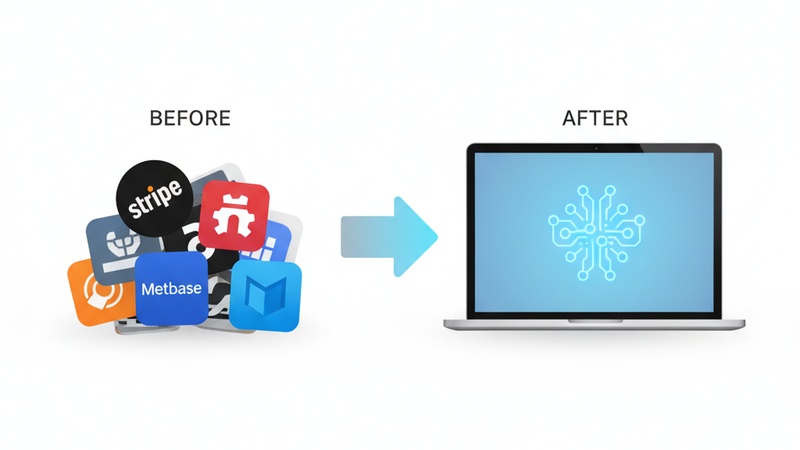
Let me be specific. Here's what I was paying for and what I replaced.
What I replaced
Business intelligence dashboards ($200/month) I was paying for Metabase hosted, plus the time cost of maintaining it. Replaced with an agentic harness that queries my data directly. I ask "how did MRR change this week?" on WhatsApp and get a sourced answer in 15 seconds. No charts to interpret. No SQL to write.
If you want the full story of why I stopped using dashboards, I wrote about it here: Stop Building Dashboards Nobody Looks At.
Data analyst time ($0 on paper, ~$50K/year in founder time) I was spending 10+ hours a week pulling numbers from Stripe, PostgreSQL, and HubSpot. Now I spend 30 minutes. The agent handles the queries, the math, and the cross-referencing. I handle the judgment about what the numbers mean.
Full breakdown here: I Replaced My Data Analyst with an AI Agent.
Basic customer support triage ($40/month Intercom AI) The AI features in support tools are getting better, but they're still chatbots — they search a knowledge base and generate plausible answers. I've started using an agent that can actually query the order database, check subscription status, and give accurate answers grounded in real data instead of guessing from FAQ docs.
Content repurposing ($29/month) I had a tool that turned blog posts into Twitter threads and LinkedIn posts. It produced generic, obviously-AI output that performed worse than my own writing. Now I use an agent that reads my actual blog posts, understands the voice, and drafts social content that sounds like me. Still needs editing. But the first draft is closer to usable.
Spreadsheet-based reporting ($0 in tool cost, enormous in time) My Monday morning ritual of pulling data from 5 tools into a spreadsheet is gone. The agent sends me a summary. If I want to dig deeper, I ask follow-up questions. No more Copy of Weekly Numbers (NEW) (2).
What I kept
Payments: Stripe. No AI agent is going to process payments better than Stripe. This is infrastructure. It works. It's compliant. The API is excellent. Keep it.
Code hosting and CI: GitHub. Same category. Infrastructure that works. AI coding assistants sit on top of it, but the repository, the PRs, the CI pipeline — that's SaaS done right.
Communication: Slack and email. Agents can draft messages and summarize threads. But real-time communication with humans is not a problem AI solves better. Yet.
Infrastructure: AWS/Vercel. Deployment, hosting, DNS. This is plumbing. Use the best plumbing you can find and don't think about it.
Accounting: QuickBooks. Tax compliance, GST filing, bank reconciliation. I could theoretically have an agent pull data from my bank and categorize transactions. But tax law changes, compliance matters, and my CA expects files in QuickBooks format. Not worth replacing.
What I'm on the fence about
CRM (HubSpot, $50/month). An agent can query my pipeline data. But HubSpot's value isn't just storing data — it's the email sequences, the deal tracking UI, the integrations with my calendar. I'm testing whether an agent can replace the querying part while I keep HubSpot for the workflow part. Jury's still out.
Email marketing ($25/month). An agent can draft better emails than most email marketing tools' AI features. But the delivery infrastructure, the list management, the analytics — that's still better handled by a dedicated tool. For now.
The agent-first mental model
Here's the shift that matters.
Old mental model: I have a question → I figure out which tool has the answer → I log in and find it → I extract the data → I interpret it.
New mental model: I have a question → I ask the agent → It queries the right system and gives me the answer.
The agent doesn't replace the tool. Stripe still processes payments. PostgreSQL still stores data. The agent sits on top and becomes the interface layer. Instead of learning 14 different UIs, I use one: natural language.
This is what I mean by "fewer tools, more agents." The tools are still there. The agents just make them invisible. You stop thinking in terms of "which app do I open?" and start thinking in terms of "what do I need to know?"
The cost comparison
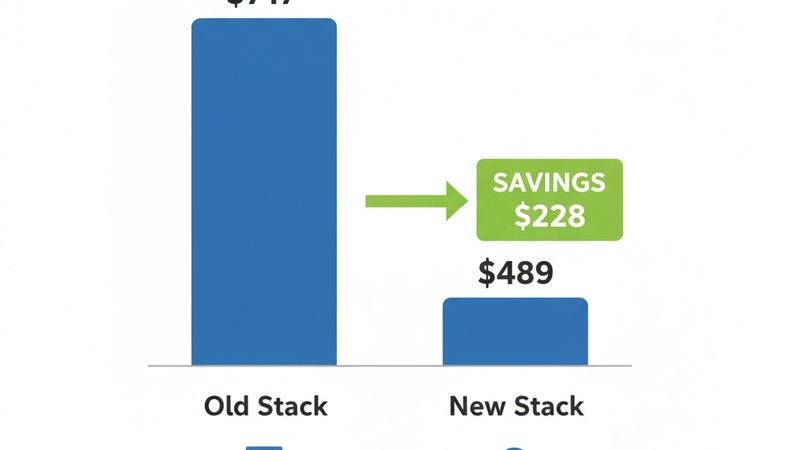
Here's the actual math for my stack.
Old stack (SaaS-first):
| Category | Tool | Monthly Cost |
|---|---|---|
| Payments | Stripe | $29 (fixed) + processing |
| CRM | HubSpot | $50 |
| Analytics | Metabase hosted | $200 |
| Support | Intercom | $39 + $40 (AI) |
| Email marketing | Mailchimp | $25 |
| Project management | Linear | $0 (free tier) |
| Communication | Slack | $8.75 |
| Code | GitHub | $0 (free tier) |
| Docs | Notion | $0 (free tier) |
| Content repurposing | Typefully | $29 |
| Accounting | QuickBooks | $30 |
| Infrastructure | AWS + Vercel | ~$200 |
| Database | Managed PostgreSQL | ~$40 |
| Monitoring | Sentry | $26 |
| Total | ~$717 + Stripe processing |
New stack (agent-first):
| Category | Approach | Monthly Cost |
|---|---|---|
| Payments | Stripe (kept) | $29 + processing |
| CRM | HubSpot (kept, querying via agent) | $50 |
| Analytics | Agent queries data directly | $0 (replaced Metabase) |
| Support | Agent with database access | $0 (replaced Intercom AI) |
| Email marketing | Kept for now | $25 |
| Project management | Linear (kept) | $0 |
| Communication | Slack (kept) | $8.75 |
| Code | GitHub (kept) | $0 |
| Docs | Notion (kept) | $0 |
| Content repurposing | Agent reads blog, drafts posts | $0 (replaced Typefully) |
| Accounting | QuickBooks (kept) | $30 |
| Infrastructure | AWS + Vercel (kept) | ~$200 |
| Database | Managed PostgreSQL (kept) | ~$40 |
| Monitoring | Sentry (kept) | $26 |
| Agent infrastructure | API costs + hosting | ~$80 |
| Total | ~$489 + Stripe processing |
Savings: ~$228/month ($2,736/year) in direct tool costs.
But the real savings isn't the subscription fees. It's the time. I estimated 10 hours/week on data tasks before, now it's 30 minutes. At $100/hour opportunity cost, that's $47,500/year in recovered time. I did the full breakdown here: The $50,000 Question.
Combined: roughly $50,000 a year in time and $2,700 in direct costs. For a bootstrapped founder, that's the difference between hiring your first employee and not.
Where agents actually help vs. where they hurt
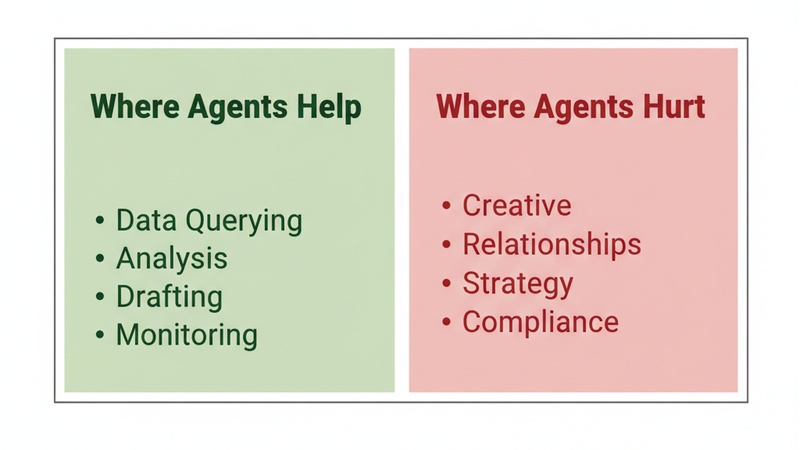
I want to be honest about this, because the "AI replaces everything" crowd is loud right now and mostly wrong.
Where agents genuinely help:
- Querying data across systems. This is the killer use case. If your data lives in 5 tools and you need to combine it, an agent is faster than you. Every time.
- Repetitive analysis. Weekly reports, monthly summaries, pipeline checks. The kind of thing you do on autopilot. An agent does it better because it doesn't forget to check a source or transpose a number.
- Drafting and summarizing. Email drafts, meeting summaries, social content. The first pass is faster with an agent. You still edit. But you edit instead of staring at a blank page.
- Monitoring and alerting. "Tell me if MRR drops more than 10% in a week." "Flag any customer whose usage drops 50% month-over-month." Setting up alerts in 5 different tools is painful. One agent watching all your data is not.
Where agents hurt or just add noise:
- Creative work that matters. Your blog posts. Your investor updates. Your sales emails to your top 10 prospects. An agent can draft these, but the draft will be generic. If the communication matters, the human touch matters more than the speed.
- Relationships. Agents don't build trust. You do. An agent can prep you for a sales call by pulling the prospect's data. But the call is yours.
- Strategy. An agent can tell you that churn went up 15%. It can't tell you whether that's because your product is broken, your pricing is wrong, or you acquired the wrong customers three months ago. Context and judgment are still yours.
- Compliance and legal. Don't let an agent file your taxes. Don't let an agent write your employment contracts. Use specialists. Pay them. It's cheaper than the alternative.
How to start (if you're a solo founder reading this)
Don't try to replace everything at once. That's how you end up with a mess of half-working agents and a bunch of cancelled subscriptions you resubscribe to a month later.
Step 1: Replace the biggest pain point first. For most solo founders, that's business intelligence — the Monday morning data pull. Connect an agent to your data sources. Ask it the 5 questions you ask yourself every week. See if the answers are faster and more accurate than your current process.
This is exactly what we built Zosma AI's Agentic Harness to do. You can read the technical explanation here: What Is an Agentic Harness?.
Step 2: Prove the value before expanding. Use the agent for one workflow for two weeks. If it saves you real time — not theoretical time, actual hours you get back — move to the next category.
Step 3: Keep the infrastructure tools. Stripe, GitHub, your database, your hosting. These are foundations. Agents sit on top of foundations. They don't replace them.
Step 4: Be honest about what you're bad at. If you're bad at consistently pulling weekly metrics, that's where an agent helps. If you're bad at writing compelling sales copy, an agent's first draft won't magically fix that. Fix the process first, then automate the improved process.
The bottom line
I set out to reduce my SaaS bill. I did — by about $230/month. But what I actually got was something more valuable: a single interface to my entire business. Instead of 14 tools, I have one conversation.
The tools I kept are the ones that do something specific and do it well. Payments. Code hosting. Infrastructure. Accounting compliance. These are SaaS at its best — focused, reliable, and worth paying for.
The tools I replaced all shared one trait: they showed me data but couldn't answer my questions. Dashboards that displayed numbers but couldn't tell me what changed. Support tools that searched docs but couldn't check actual order status. Reporting scripts that broke every time an API changed.
If a tool makes you smarter about your business, keep it. If it makes you a data entry clerk, replace it.
The solo founder's AI stack isn't "replace everything with AI." It's "keep what works, replace what doesn't, and put an agent in the middle so you can actually use the data you're paying for."
That's a smaller change than it sounds like. And a bigger one than you'd expect.