The $50,000 Question — Why Hiring a Data Team Is No Longer Your Only Option
A junior data analyst costs $55K/year before benefits. An AI agent costs a fraction of that. Here's when each one makes sense.
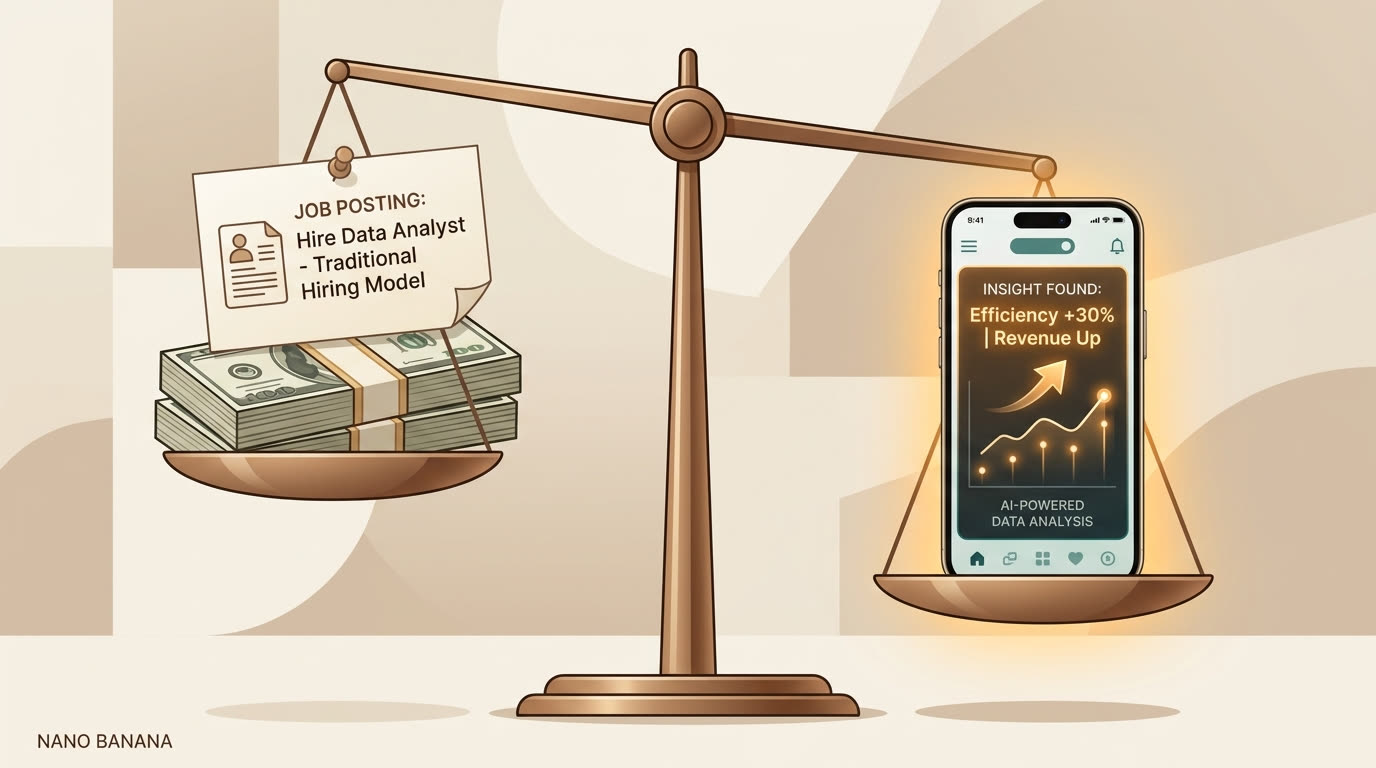
I wrote the job description three times.
"Data Analyst — early-stage startup, must be comfortable with ambiguity, must know SQL, Python preferred, must be willing to also do customer support sometimes because we're four people." I stared at it. It read like a parody of startup hiring. But it was real. I needed someone to make sense of our data, and I couldn't keep spending every Monday morning doing it myself.
So I did what any founder does: I researched the salary. Glassdoor said $55K on the low end for a junior in a mid-cost market. $80K if I wanted someone who wouldn't need hand-holding. Add benefits, payroll taxes, and equipment, and I was looking at $70K to $100K all-in for year one. Plus a recruiter's cut if I didn't want to spend three months sourcing candidates myself.
That was nearly half my annual runway. For one person.
I didn't hire. Not because I didn't need the help — I desperately did. I couldn't afford it. And talking to other founders, I realized most of them can't either. They're in the same spot: drowning in data spread across a dozen tools, knowing the answers are in there somewhere, but unable to justify a six-figure commitment to find them.
This post is the math I wish someone had shown me a year ago.
What the traditional path actually costs
Let's be specific. Not "it depends" specific. Real numbers, real sources.
The hire
According to the Bureau of Labor Statistics Occupational Outlook and Glassdoor's 2025 salary data, here's what data analysts cost in the US:
- Junior data analyst: $55,000–$70,000/year
- Mid-level: $75,000–$95,000/year
- Senior: $100,000–$130,000/year
But that's base salary. The BLS Employer Costs for Employee Compensation report puts total compensation costs at 20–30% above base salary when you factor in benefits, payroll taxes (FICA, unemployment insurance), health insurance, and equipment. A $55,000 junior costs your company $66,000–$71,500. A $75,000 mid-level costs $90,000–$97,500.
Source: BLS, "Employer Costs for Employee Compensation," December 2025.
The tools
Your new analyst needs something to work with. These are real pricing ranges from current plans:
| Tool Category | Examples | Monthly Cost |
|---|---|---|
| BI platform | Looker, Tableau, Metabase Cloud | $500–$2,000 |
| Data warehouse | BigQuery, Snowflake | $200–$1,000 |
| ETL/integration | Fivetran, Airbyte Cloud | $300–$1,500 |
That's $12,000–$54,000/year in tooling alone. And these tools have a way of creeping upward. Snowflake bills by compute. BigQuery bills by query volume. The bill in month six rarely looks like the bill in month one.
The hidden costs
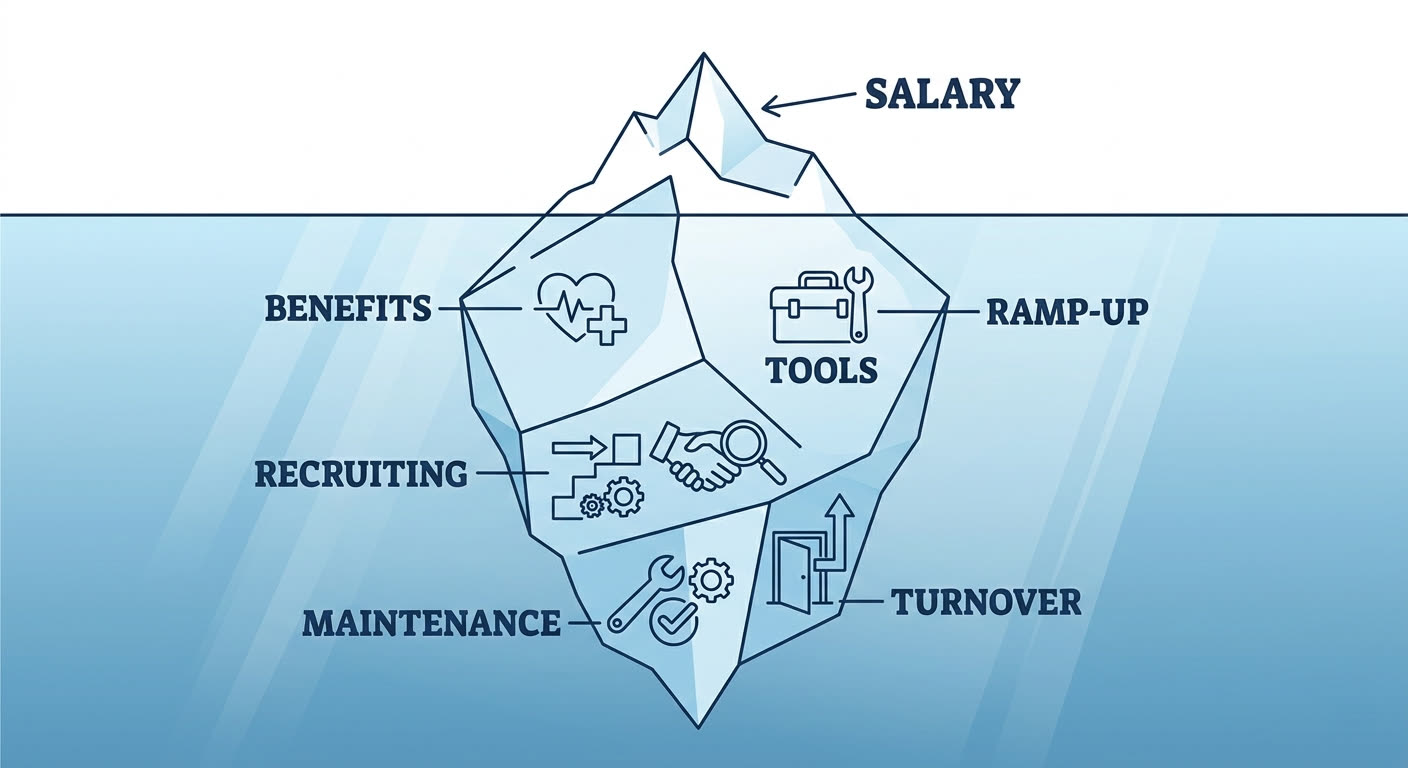
This is where the iceberg goes underwater.
Recruiting. If you use an agency, expect to pay 15–25% of the first-year salary as a placement fee. For a $70,000 hire, that's $10,500–$17,500. Even if you recruit yourself, there's the time cost: writing the description, screening resumes, running interviews, checking references. I've seen founders spend 40+ hours on a single hire.
Ramp-up. A new analyst doesn't produce value on day one. They need to learn your systems, understand your data quirks, build context on the business. Expect 2–4 months before they're fully productive. During that time, you're paying full salary for partial output.
Maintenance burden. Here's the number that surprised me most. According to Anaconda's State of Data Science report, data professionals spend 40–60% of their time on data preparation and pipeline maintenance — cleaning data, fixing broken ETL jobs, updating dashboards, troubleshooting why last Tuesday's numbers don't match. Not doing analysis. Maintaining the infrastructure that makes analysis possible.
So that analyst you hired to find insights? They're spending half their week keeping the lights on.
Turnover. LinkedIn Workforce data puts the average tenure for data analysts at roughly 2 years. Then they leave — for higher pay, a bigger company, a more interesting dataset. And you start over. New job posting. New recruiter fee. New 3-month ramp-up. The institutional knowledge walks out the door.
The total
Let me lay out two scenarios.
Conservative (junior hire, basic tools, no recruiter):
- Salary + benefits: $66,000
- Tools: $12,000
- Year-one total: ~$78,000
Realistic (mid-level hire, proper tooling, recruiter, ramp-up):
- Salary + benefits: $90,000
- Tools: $24,000
- Recruiter: $15,000
- Ramp-up productivity loss: ~$15,000 (3 months at ~50% productivity)
- Year-one total: ~$144,000
For context, the median seed round in 2025 was $3.6M, according to Carta's State of Private Markets report. The traditional data path eats 2–4% of your entire round. Just to know how the business is doing.
Year two is cheaper — no recruiter fee, no ramp-up. But you're still looking at $78,000–$114,000 annually. And that assumes your analyst stays.
The AI agent path
So what does the alternative look like? Not in theory. In practice.
What you need is an agentic harness — a system that connects to your existing tools (your database, Stripe, CRM, whatever you're already running) and lets you ask questions in plain language. We wrote a full technical explainer in What Is an Agentic Harness?, but here's the practical version.
Setup takes hours, not months. You connect your data sources, define what the agent can access, set permission boundaries. There's no three-month ramp-up because there's no institutional knowledge to build. The agent reads from your systems directly. Your data IS the context.
Monthly cost is a fraction of a full-time hire. The exact number varies by provider, usage volume, and which tools you connect. But we're talking about a difference measured in orders of magnitude, not percentages. Even on the high end, you're comparing thousands per year to six figures.
What it replaces well: roughly 70% of what a data analyst does day-to-day. Routine queries ("what was revenue last week?"), dashboard maintenance, report generation, cross-referencing data from multiple tools. The stuff that eats 40–60% of an analyst's time on infrastructure alone, plus most of the standard queries they run.
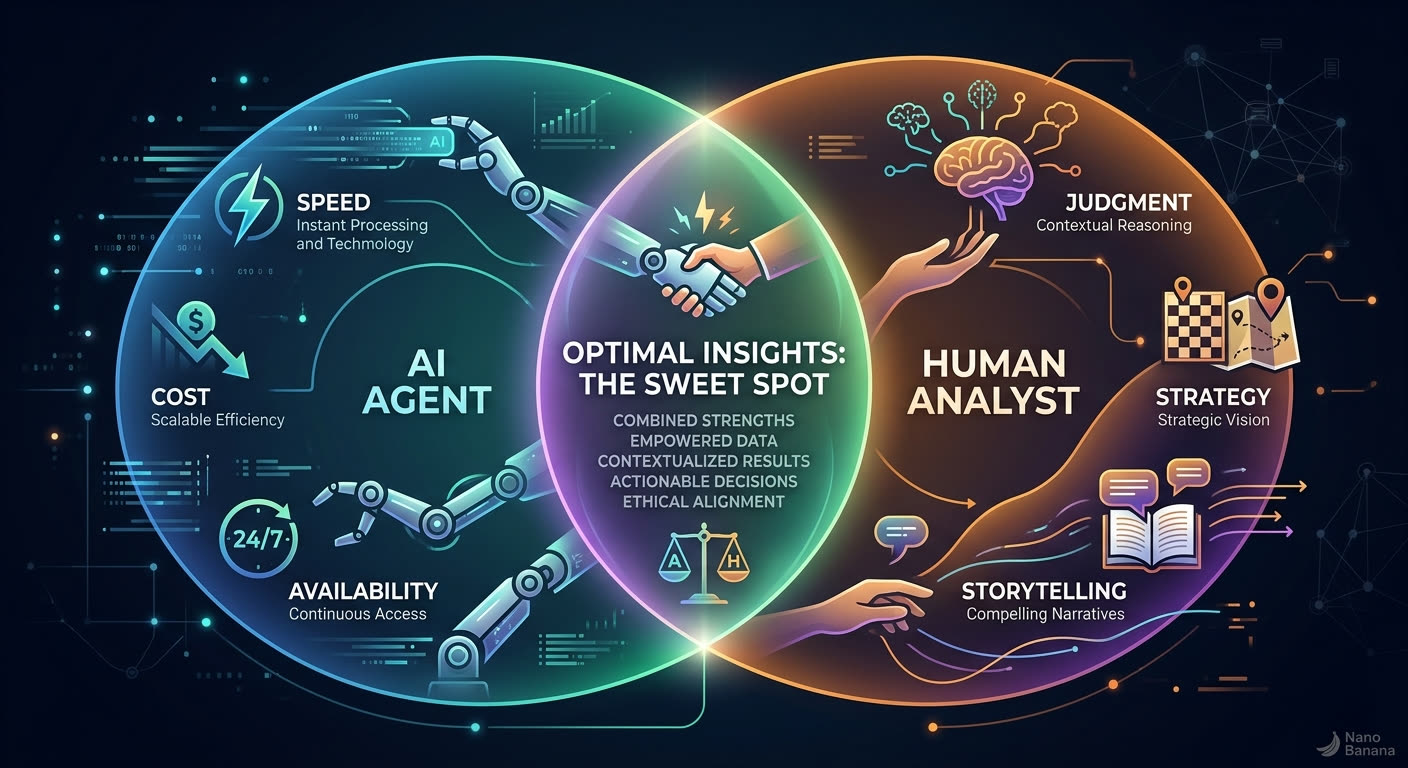
What it doesn't replace — and I want to be honest about this. Novel analysis where someone looks at data and sees a pattern nobody asked about. Data strategy — deciding what you should even be measuring. Stakeholder presentations where a human reads the room and adjusts the narrative. Building a data culture on your team. These are human skills. An agent is a tool, not a colleague.
Time to value: The traditional path is 2–4 months before you get full productivity. An AI agent is productive in hours, available 24/7, and doesn't take PTO in August.
The honest comparison
Here's the table. I've tried to be fair to both sides.
| Capability | Human Data Analyst | AI Agent |
|---|---|---|
| Routine queries | Minutes to hours | Seconds |
| Cross-system analysis | Manual, error-prone | Automated, consistent |
| Novel insights | Strong — sees patterns you didn't ask about | Weak — only finds what you ask |
| Data strategy | Strong | None |
| Stakeholder communication | Strong | None (provides inputs, not narratives) |
| Availability | Business hours, takes PTO | 24/7 |
| Consistency | Varies by person, by day | Same methodology every time |
| Cost (year 1) | $78K–$144K+ | Fraction of that |
| Ramp-up time | 2–4 months | Hours to days |
| Turnover risk | High (~2-year avg tenure) | None |
| Handles ambiguity | Strong | Weak — needs clear questions |
Look at that table and notice what's NOT highlighted. The AI agent doesn't win everywhere.
Humans are better at seeing things you didn't think to look for. They're better at telling the story behind the numbers. They're better at knowing what questions to ask in the first place. A great analyst walks into a meeting and says "I noticed something weird in the cohort data — I think our onboarding flow is broken for mobile users." An agent will never do that unprompted. It answers what you ask. It doesn't wander.
If you need someone to build a data strategy from scratch, to present to your board, to decide what your company should even be measuring — you need a human. An agent won't do that. And anyone who tells you otherwise is selling you something.
But if your question is "what happened last week?" or "how's churn trending?" or "which marketing channel drove the most revenue this quarter?" — you don't need a $90,000 human to run that query. You need a system that's connected to your data.
The sweet spot
Here's how I'd frame the decision.
AI agent wins when:
- You're a solo founder or small team (1–20 people)
- You need answers from data you already have
- Most of your questions are "what happened?" not "what should we do?"
- You can't afford — or don't yet need — a full-time data person
- Speed matters more than narrative
Human analyst wins when:
- You need a data strategy, not just data access
- You're presenting to investors or a board regularly
- You're doing predictive modeling or complex statistical work
- Your data quality is a mess and needs human cleanup before it's queryable
- You need someone to own the data function as the company grows
The hybrid — where most growing companies eventually land: AI handles 70% of the work: the routine queries, the daily check-ins, the weekly reports, the cross-referencing across tools. A human handles the 30% that requires judgment, strategy, and storytelling. Some companies get there by hiring a part-time analyst who focuses on high-value work while the agent handles everything else. The analyst stops spending half their week fixing pipelines and starts spending it on actual analysis.
That's a better job for the human, too.
What about the middle ground?
Fair question. AI agents aren't the only alternative to a full-time hire. Let me walk through the usual suspects.
Fractional or contract analysts. $50–$150/hour depending on seniority and market. Good for defined projects: "build me a retention dashboard," "audit our data pipeline." Bad for ongoing, ad-hoc needs. You can't Slack a contractor at 9pm on a Sunday when you notice something weird in the numbers. And every new project requires re-establishing context.
Offshore analysts. $15,000–$30,000/year for markets like India or the Philippines. Real cost savings. But timezone gaps mean you're waiting 8–12 hours for answers to simple questions. Communication overhead is real — explaining business context across cultural and linguistic differences takes time. And you still have the ramp-up and turnover problems, just at a lower price point.
Managed analytics services. $2,000–$5,000/month for a service that handles your dashboards and reporting. The catch: you're their 15th client. Response times are measured in days, not seconds. Custom queries go into a queue. And the quality depends entirely on which analyst they assign you — you don't get to pick.
Each of these has real trade-offs. None of them are bad options in the right context. An AI agent doesn't make them obsolete. But it changes the calculus. The routine 70% that used to justify a full-time hire or an ongoing contract? That's the part an agent absorbs. The remaining 30% is where you decide: do I need a human for this, and how much of their time do I actually need?
Make your own call
The question was never "should I hire a data analyst or use AI?" That's a false binary, and I've been careful not to frame it that way.
The real question is: what do I actually need, and what can I afford?
For most solo founders and small teams, the honest answer is: an AI agent for day-to-day data access, plus your own judgment for strategy. You already know your business better than any junior analyst you'd hire in their first three months. What you're missing isn't interpretation. It's access — fast, reliable access to the numbers trapped inside your own tools.
The $50,000–$100,000 you don't spend on a premature hire isn't just money saved. It's runway. It might be another 6–8 months of building before you need to raise again. It might be the difference between hiring an engineer who ships product and hiring an analyst who spends half their time maintaining Fivetran connectors.
I wrote about my own experience making this switch if you want the personal version. And if you're curious about the technical architecture — how an agent actually connects to your systems and queries real data — we covered that in What Is an Agentic Harness?.
Your business already generates the data. The question is whether you need an $80,000-a-year human to read it for you — or whether a better interface to your own systems would do.