Private AI for Business: Keep Customer Data Secure in 2026
Why private AI infrastructure is essential for businesses handling sensitive data. Run AI models locally with zero data exfiltration. Compliance, cost, and control.
Private AI for Business: Keep Customer Data Secure in 2026
Key Takeaways
- 56% of enterprises now run production AI on private cloud, up from 41% using public cloud in 2026 (Broadcom Private Cloud Outlook 2026).
- Privacy blocks or will block AI projects for 89% of practitioners working with sensitive data (Protopia Inference Privacy Report, 2026).
- India's DPDP Act carries penalties up to ₹250 crore for data breaches, making local AI a compliance necessity.
- Running open-weight models locally costs up to 18x less per million tokens at high-volume workloads compared to premium cloud APIs.
The Shift to Private AI in 2026
For the past three years, most AI architecture decisions came down to one question. Which cloud API should you call. Anthropic, OpenAI, Google, Meta, or one of the Chinese AI labs. The model ran on their hardware. Your data passed through their infrastructure. They decided who could see it.
That calculus changed in 2026. Fifty-six percent of enterprises are now running or planning to run production AI inference on private cloud. Public cloud usage for the same workloads fell 15 percentage points in a single year, from 56% to 41%. The numbers come from Broadcom's Private Cloud Outlook 2026 survey of 1,800 senior IT decision-makers. The shift is not theoretical. Organizations are moving workloads home.
The reason is simple. Public cloud is too expensive and not governed enough for AI at scale. As inference becomes part of core applications, organizations need predictable performance and tighter data control. The three Cs drive the decision. Cost, complexity, and control.
When you run models locally, you can share almost anything with zero risk. Anthropic, OpenAI, Google, Meta, and the Chinese AI labs cannot see your data because the model runs on your own hardware. No API calls. No data pipelines you don't control. No terms of service that change overnight.
Why Privacy Blocks AI Projects
The problem is not whether companies want to use AI. They do. The problem is data risk. Eighty-nine percent of AI practitioners say privacy concerns have blocked or will block their projects involving sensitive data, according to Protopia's Inference Privacy Report from a 2026 survey of over 350 AI practitioners at companies including Oracle, Disney, Wells Fargo, Cisco, and NVIDIA.
Half of all practitioners have not brought sensitive data into AI at all. The other half is split between sandbox testing and production. That means most organizations are leaving real AI use cases on the table because they cannot guarantee data protection.
This is where private AI changes the equation. When models run on your own infrastructure, there is no third-party data processing. No prompt logs sitting on someone else's servers. No model provider with legal access to your queries under their terms of service.
The Cisco 2026 Data and Privacy Benchmark Study found that 90% of organizations expanded their privacy programs specifically because of AI. Forty-three percent increased privacy spending over the past year. Seventy-seven percent identify intellectual property protection of AI datasets as a top governance challenge.
The Cost of Cloud AI at Scale
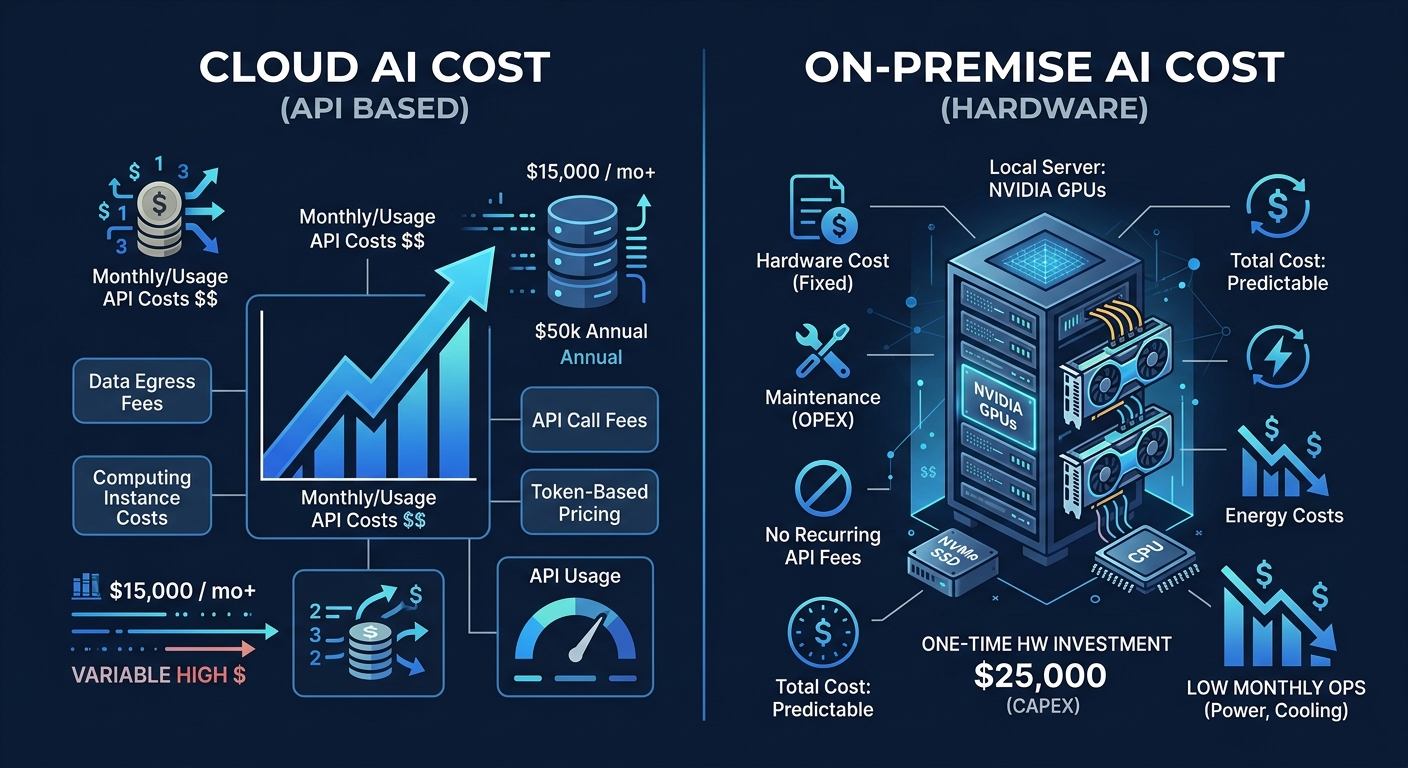
The economics are the other half of the argument. At pilot scale, cloud APIs look fine. A small usage volume keeps the bill manageable. Production is a different story entirely. A workload that costs $2,000 per month in testing can reach $200,000 per month in production without architectural changes, according to the enterprise local AI stack research from VDF AI.
Cost management overtook security as the number one public cloud concern in 2026. Thirty-one percent of IT leaders cited cost as their top challenge, up from 26% in 2025. Ninety-seven percent of IT leaders believe some portion of their public cloud spend is wasted. More than half say that waste exceeds 25% of their total budget.
Running open-weight models locally collapses variable costs to near zero at scale. You pay for the hardware upfront. You only pay for electricity after that. The breakeven point depends on your volume. Solo developers and very small teams might still benefit from cloud APIs at low volumes. Startups running 3 to 5 million tokens per day cross the breakeven around 36 months. Heavy users processing 50 million tokens or more per day see local deployment become economically dominant.
Regulatory Pressure and Data Sovereignty
Regulations make the private AI case even stronger. India's Digital Personal Data Protection Act carries penalties up to ₹250 crore for failure to maintain reasonable security safeguards. The DPDP Rules, 2025, notified on 14 November 2025, operationalized the law with an 18-month compliance timeline. The Data Protection Board of India now functions as the enforcement body.
For businesses in India that handle customer data, sending that data to cloud AI providers like OpenAI or Google in US data centers creates genuine compliance risk. Local deployment eliminates the cross-border data transfer question entirely. Your data stays in your jurisdiction. On your hardware. Under your control.
The picture is similar across borders. Sixty-eight percent of organizations in regulated sectors report private AI as their primary deployment mode, according to Cabrillo Club's 2026 Private AI benchmarks survey of 312 professionals. Data residency and jurisdiction concerns are the top deployment blocker for 52% of organizations. That figure exceeds cost and model quality combined.
How Private AI Works in Practice
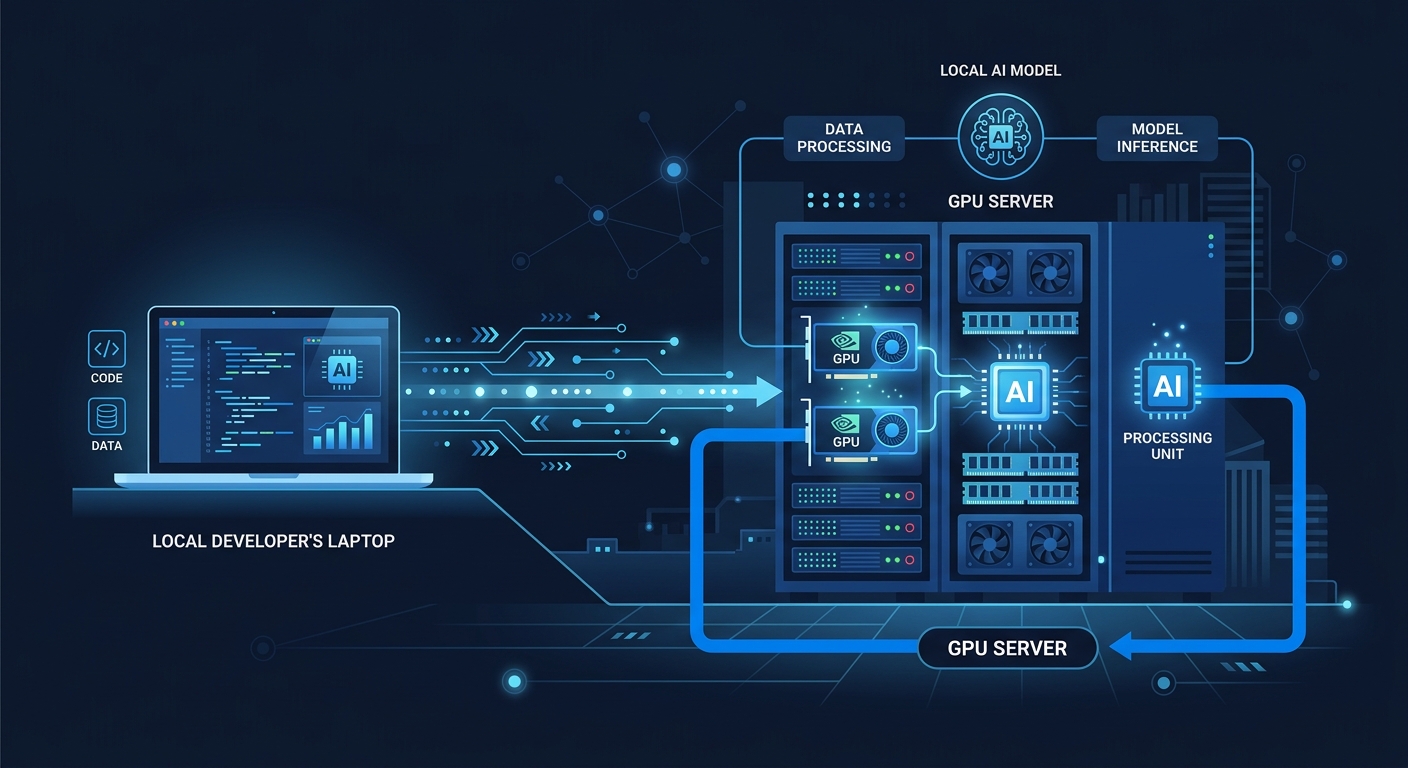
The architecture is simpler than most people expect. You need hardware with enough VRAM to load an open-weight model. You need an inference runtime. You need the model weights. That is the foundation.
Zosma uses a practical setup that covers this. The local stack includes an RTX 5090 with 32GB of VRAM, an RTX 3080 with 12GB, and an RTX 2070 SUPER with 8GB. That totals around 52GB of VRAM across the system. The primary model is Qwen 3.6 27B running on the RTX 5090. It handles document processing, research, content generation, data extraction, and conversation routing at a level comparable to DeepSeek V4 Flash for non-coding automation tasks.
This is Zosma Cowork in action. It is desktop-based co-worker software that helps people work with AI using local models. Private-first, unlimited, no cloud APIs. You get unlimited intelligence for learning and self-improvement. The only ongoing cost is electricity.
For enterprise deployments, the pattern is similar but at larger scale. A minimal production setup can run on two to four servers. One for the platform stack. One or more for GPU inference. One for storage. Organizations that deploy one model on their own infrastructure find that deploying a second one is significantly faster and cheaper.
What Businesses Lose to Cloud Providers
When you send data through cloud AI APIs, you are giving up more control than most people realize. Here is what happens with the major providers.
OpenAI can use your prompts and responses to improve their models unless you pay for an enterprise plan with specific training exclusions. Anthropic's terms allow usage logging for safety and quality purposes. Google processes data through their infrastructure. Meta's AI services run through their systems. Chinese AI labs operate under their own data governance frameworks.
The contractual guarantees sound reassuring until you read the fine print. Training exclusions can change when terms of service update. Safety logging still means someone at the provider has visibility into your queries. Third-party subprocessors may handle your data without explicit contractual boundaries.
Only 55% of organizations require clear contractual terms outlining data ownership, usage rights, and intellectual property parameters when working with AI vendors, according to Cisco's 2026 study. Organizations may trust their vendors, but informal trust does not hold up in a regulatory audit.
Getting Started with Private AI
The barrier to entry is lower than it was two years ago. Consumer-grade GPUs handle inference well enough for most business tasks. A used RTX 3090 costs around $700. Enterprise cards like the A6000 run about $2,800. Ollama is the default runtime for teams serving fewer than 10 concurrent users. vLLM handles production workloads with 50 to 500 concurrent users.
The open-weight model ecosystem is mature. Models like Qwen 3.6, Llama 3.1 70B, Mistral Large 3, and Phi-4 14B cover everything from chat and RAG to code generation and structured output. The performance gap between open-weight models and proprietary frontier models sits at roughly 15-25% on common reasoning benchmarks. For most business tasks, that gap falls within the noise floor.
Zosma also built local AI agents that connect to Tally ERP. Automate bookkeeping, invoicing, GST reports, and reconciliation. All running on-premise. No data leaves your system. This is the practical application of private AI for Indian businesses that handle financial data.
Frequently Asked Questions
Is private AI cheaper than cloud AI?
Yes, once you cross a certain usage threshold. Low-volume workloads under 500,000 tokens per day may still be cheaper on cloud APIs. Medium to heavy usage makes local deployment economically dominant. You pay for the hardware upfront, then only pay for electricity. The breakeven typically arrives around 36 months for mid-market companies.
Can local models match cloud API quality?
For most business tasks, yes. Open-weight models in 2026 handle chat, RAG, document processing, and structured output at near-frontier levels. The gap is most visible on long-context reasoning over 200K tokens and the very latest multimodal capabilities. Most organizations do not need frontier performance for their core workflows.
What about compliance with India's DPDP Act?
Running AI locally keeps personal data within your infrastructure and jurisdiction. You avoid cross-border data transfers entirely. The DPDP Act's penalties for security failures reach ₹250 crore. Local deployment is the most straightforward way to demonstrate reasonable security safeguards and data localization compliance.
How much hardware do I need?
For a small team, a single GPU server with 16 to 32GB of VRAM handles most tasks. Consumer cards in the RTX 4080 to RTX 5090 range work for individual users and small teams. Enterprise deployments typically use multiple GPU servers. The exact requirement depends on model size, quantization level, and concurrent user count.
Is private AI the same as sovereign AI?
Related but not identical. Local AI means running models on end-user or on-premises hardware. Sovereign AI is broader and covers any deployment where your organization controls data residency and model governance. Running models in your own data center is sovereign AI. Running models on employee laptops is both local AI and sovereign AI.
Take Control of Your AI Infrastructure
The infrastructure for private AI is mature. The models are capable. The compliance case is clear. The economics work at scale. You can share almost anything with zero risk when the model runs on your own hardware.
If your business handles customer data, financial records, proprietary documents, or any information that cannot leave your control, the answer is straightforward. Run AI locally. You only pay for electricity.
The best time to build your private AI infrastructure is before your AI usage grows into the expense tier. Start small. Deploy one model. Learn the stack. Scale from there.
Related reading: