Automate Your Entire Company with Local AI Agents
Using local AI agents like Pi, Hermes, and OpenClaw, you can build a team of digital workers that writes blogs, analyzes SEO, generates reports — all without sending customer data to proprietary AI companies.
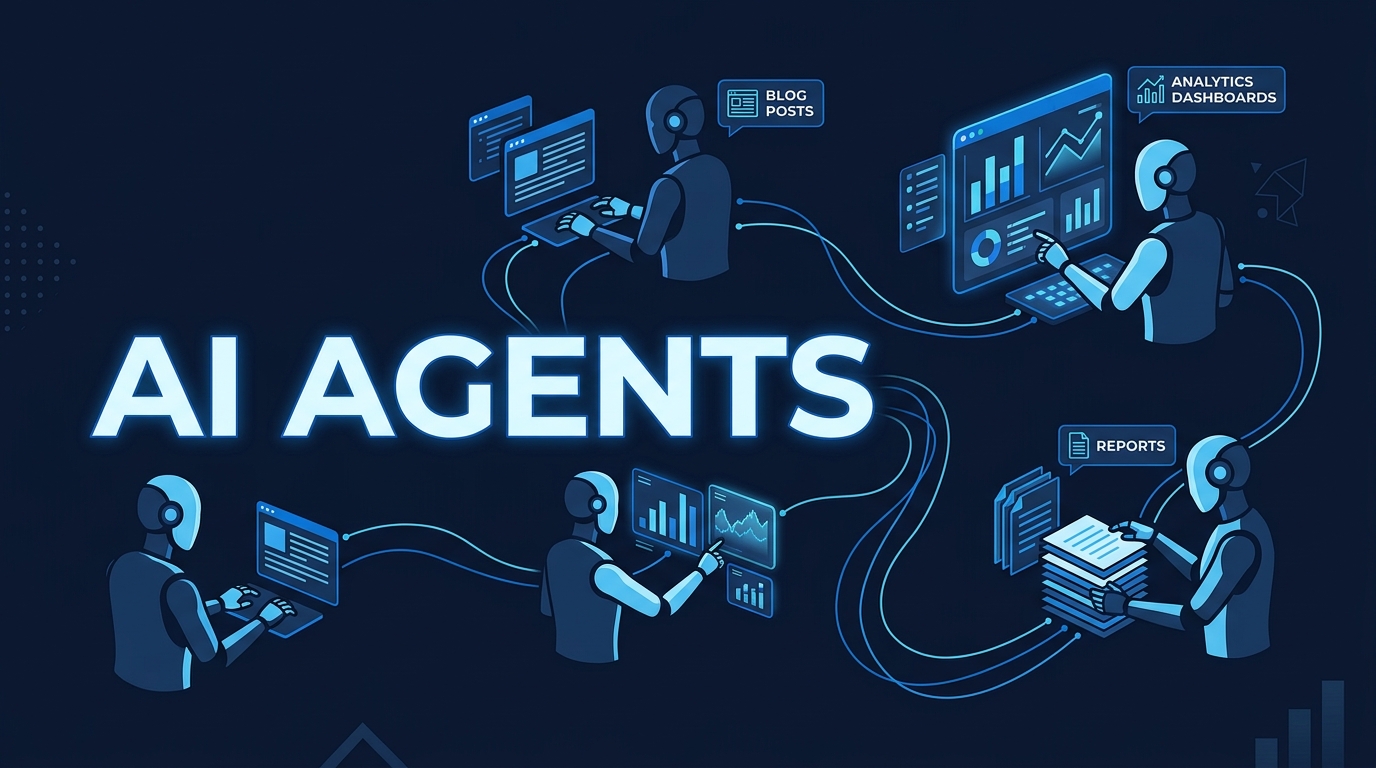
The Knowledge Work Problem
Knowledge work — writing, analysis, reporting, research — accounts for roughly 60-70% of a modern company's output, but most of it is repetitive. Blog posts follow the same structure. SEO audits check the same metrics. Weekly reports pull from the same dashboards. Marketing reviews examine the same KPIs.
The problem is that every time you hand this work to a cloud AI — OpenAI, Anthropic, Google — you're sending your company's data, your customer information, your strategy documents, and your analytics into someone else's servers.
Local AI changes that equation entirely.
Key Takeaways
- AI agents like Pi, Hermes, and OpenClaw can automate 60-70% of a company's repetitive knowledge work — blog writing, SEO analysis, analytics, reporting
- With local AI, all of that automation runs on your hardware. Your customer data never leaves your infrastructure
- A single rig with an RTX 5090 and a 27B model can handle most knowledge work tasks that previously required cloud APIs
- Open-source agent frameworks are mature enough for production — Pi handles research, Hermes runs automation loops, OpenClaw orchestrates tasks
- The privacy benefit is decisive: no Data Processing Agreements, no cross-border transfers, no vendor lock-in on your core data
Digital Workers — Your AI Team
The shift in 2026 is not "AI that helps you write." It's AI that works for you.
Agents are digital workers. You give them a job, they do it, they report back. You don't sit there typing prompts. You manage a team.
Pi is a research agent — you point it at a topic and it does the work: searches, synthesizes, drafts. Hermes is an automation agent — it runs loops, executes skills, manages recurring tasks like weekly SEO reports or blog publishing pipelines. OpenClaw orchestrates tasks across systems — connecting databases, generating reports, coordinating with other agents.
Together, they cover most of what a company's knowledge workers do:
- Content creation — blog posts, social media, newsletters, documentation
- SEO analysis — crawling your site, auditing pages, suggesting optimizations, tracking rankings
- Analytics reporting — pulling from your own databases, generating weekly/monthly reports on performance
- Marketing operations — competitive analysis, campaign planning, content calendar management
- Research — market analysis, trend reports, competitive intelligence
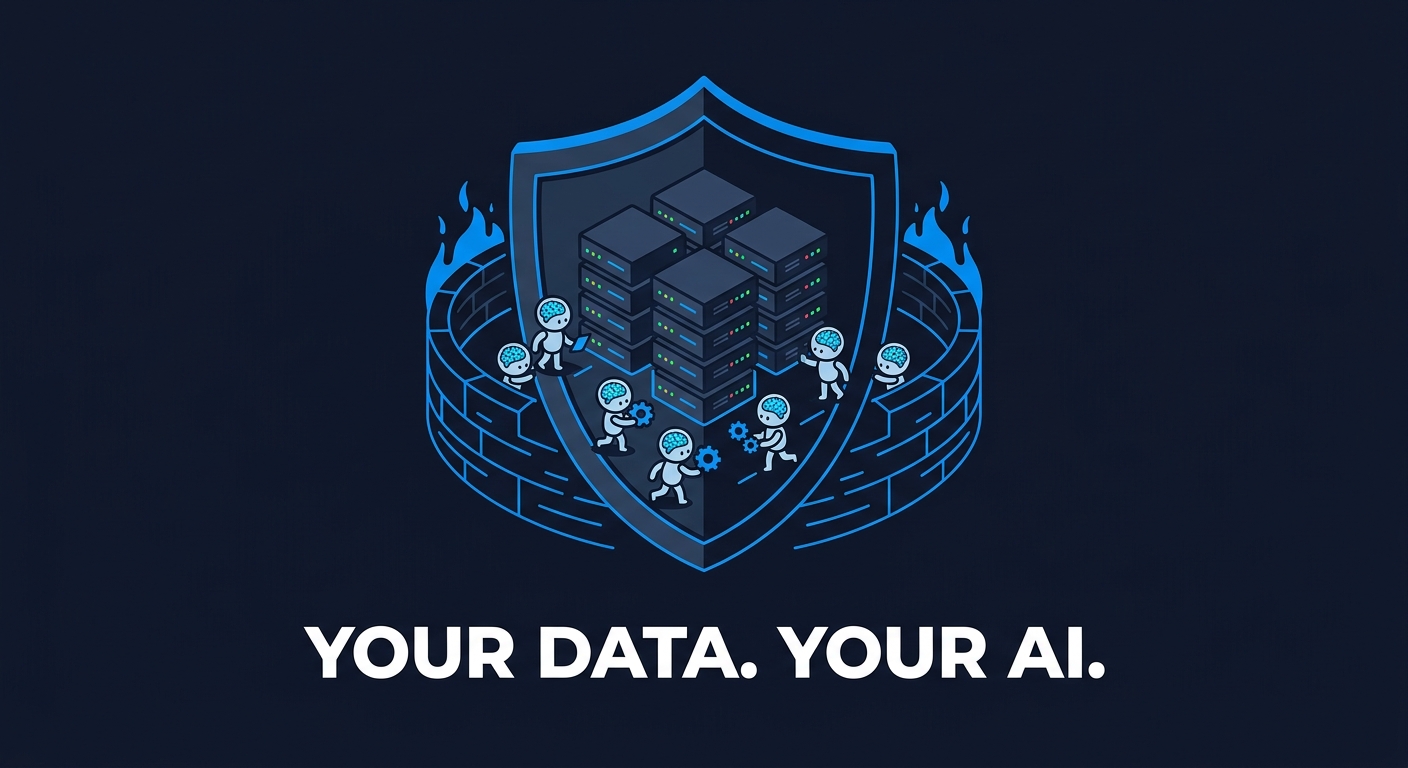
When these agents run on local AI, every prompt, every document, every data point stays on your infrastructure. No Anthropic API call. No OpenAI endpoint. No Google processing your customer database.
Privacy — Your Customer Data Never Leaves
This is where local AI agents separate from every cloud AI offering.
Send your customer database to a cloud AI for analysis and you've just violated the trust of every customer whose data is in there. From a compliance standpoint, you're now a data processor with all the legal obligations that entails — GDPR data processing agreements, cross-border transfer mechanisms, breach notification chains.
With local AI agents, none of that applies.
Your agents query your own databases. They analyze your own analytics. They process your customer information — all on your hardware. No API call carries your data across the internet to a third party's servers. Anthropic, OpenAI, Google, and every other AI company can't see your data because the model runs on your machine.
From a compliance standpoint, this is the simplest possible architecture. Your data minimization requirements are satisfied by default. Your data residency requirements are satisfied because the data never leaves.
This changes what you can automate. With cloud AI, you have to sanitize your data, redact sensitive details, and ask the model to work with incomplete information. The output is worse. With local AI, your agents see the same data you see — full context, real numbers, actual customer information — and the output is dramatically better.
Content Automation — Blogs That Write Themselves
Here's what a local AI blog-writing pipeline looks like:
Pi researches a topic — searches the web, finds sources, collects statistics. Hermes takes the research and writes a full blog post with proper frontmatter, quality-gates it against a scoring rubric, generates a thumbnail using an image model, saves it as an MDX file, and creates a PR to your website. The entire pipeline runs locally. No content ever touches a cloud API.
The post is published. SEO is baked in from the start — proper meta tags, internal links, structured headings, keyword optimization. The next week, Hermes checks performance metrics, finds gaps, and suggests the next topic.
This is not theoretical. This is the pipeline that produces the posts on this site.
SEO and Analytics — Automated at Scale
SEO agents running locally can crawl your entire website, audit every page, and generate reports — without sending your site's data to a third party.
A local agent can:
- Crawl your sitemap and score every page on titles, meta descriptions, headings, schema markup
- Pull live data from Google Search Console and Analytics (your own data, your own API)
- Track keyword rankings and identify opportunities
- Generate weekly performance reports with trends, recommendations, and action items
- Identify content gaps and suggest new blog topics
All of this runs on local AI. The agent reads your analytics data locally, processes it through a local model, and produces reports that stay on your infrastructure. No SaaS subscription. No data exfiltration.
For a company that handles sensitive customer data — healthcare, finance, or any regulated industry — this is not just a cost savings. It's a compliance requirement.
Analytics Reports From Your Own Database
One of the most powerful applications of local AI agents is automated reporting.
Your database contains the truth about your business. But extracting insights from it — joining tables, calculating metrics, generating narratives — takes human time. A local AI agent can connect directly to your database, run queries, calculate metrics, and generate natural-language reports.
Weekly revenue reports. Monthly churn analysis. Campaign performance summaries. Customer segmentation reports. All generated by an agent that runs on your hardware, queries your own data, and produces output that stays private.
With cloud AI, you'd need to extract data into a sanitized format, send it to an API, and hope the provider's security promises hold. With local AI, the agent sits next to your database. The query runs locally. The report is generated locally. Your data never leaves.
The Agent Stack — Pi, Hermes, OpenClaw
Here's how the three agent types work together:
Pi — Research agent. Given a topic, it searches, reads, synthesizes, and produces structured research output. Best for: blog research, competitive analysis, market reports, trend identification.
Hermes — Automation agent. Runs recurring tasks on schedule. Best for: weekly SEO reports, blog publishing pipelines, analytics dashboards, content calendar management, data processing loops.
OpenClaw — Task orchestrator. Coordinates work across systems and other agents. Best for: complex workflows that span multiple tools, cross-agent coordination, system integration.
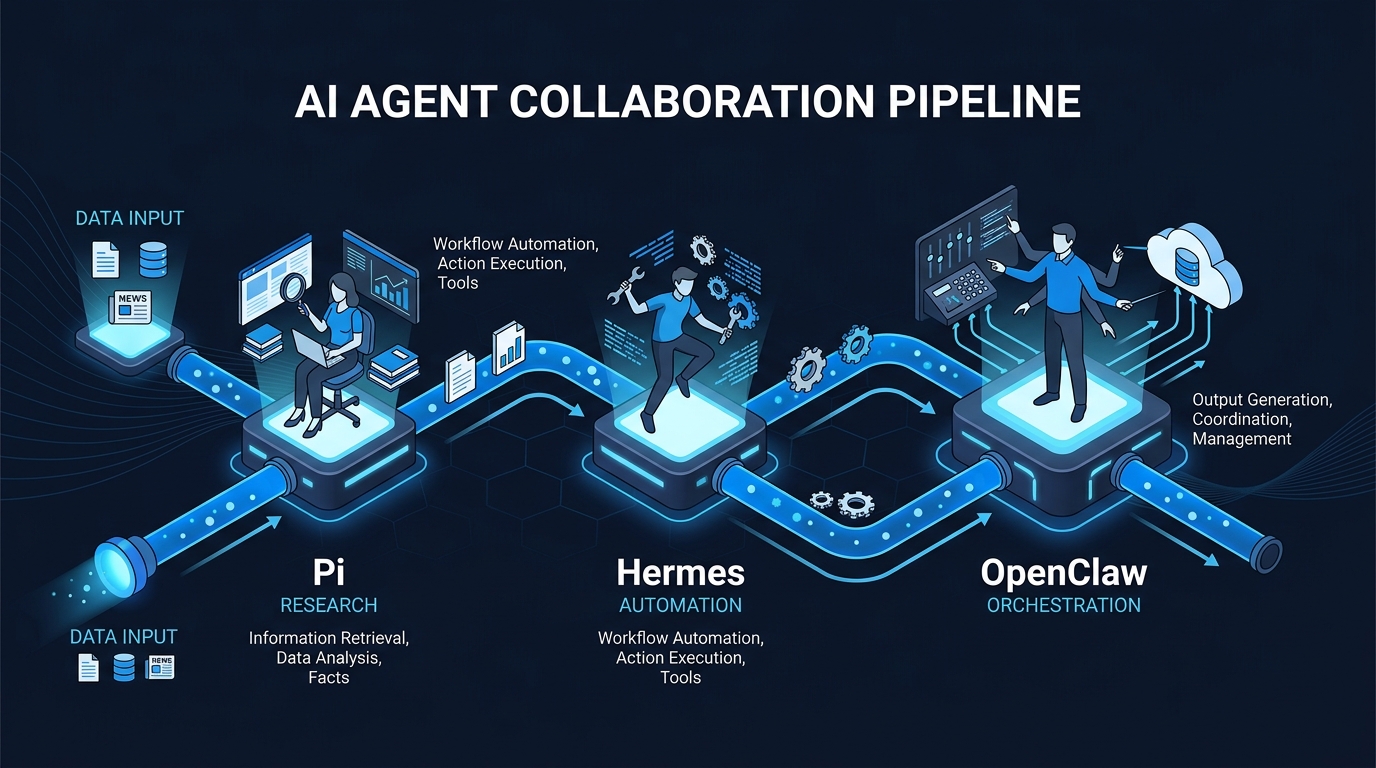
In practice, a company's automation looks like this:
- Pi researches blog topics weekly
- Hermes writes the posts, generates images, publishes via PR
- Hermes runs SEO audits on the site
- OpenClaw coordinates between Pi's research and Hermes' publishing
- Hermes generates weekly analytics reports from the company database
- All of it runs on local hardware. All of it stays private.
What We Run — Our Agent Infrastructure
At Zosma, this is our default. Three GPUs, ~52GB VRAM total:
- RTX 5090 (32GB) — runs Qwen 3.6 27B for complex reasoning, blog writing, research synthesis
- RTX 3080 (12GB) — runs 7-14B models for classification, SEO scoring, extraction tasks
- RTX 2070 SUPER (8GB) — handles embeddings and lightweight routing
Qwen 3.6 27B on the 5090 handles most of the heavy lifting — blog writing, research synthesis, report generation, data analysis. For these workloads, it's on par with cloud models and infinitely more private.
The ~52GB across three GPUs lets us run multiple models in parallel — all local, all private, all unlimited. No token budget. No rate limits. No vendor decisions that could take our tools away overnight.
The Honest Assessment — Where Cloud Still Wins
Local AI agents are not better for everything. Cloud still wins for:
- Frontier multimodal tasks (large-scale image/video generation)
- Long-context reasoning over 200K tokens
- Bursty, unpredictable workloads where hardware would sit idle
- Rapid experimentation with new models before committing
For knowledge work — writing, analysis, reporting, research — local AI agents cover the vast majority of what a company needs. The privacy advantage alone makes it the right choice for most internal work.
The Bottom Line
The question is no longer "can AI automate knowledge work?" — it can. The question is "who sees your data while doing it?"
Local AI agents automate the repetitive work — blogs, SEO, analytics, reports — while keeping your customer data, your strategy, and your analytics entirely private. You only pay for electricity. You only need hardware you already own.
The era of sending your company's data to cloud AI companies for automation is over. Build the workers, run them locally, keep your data yours.
Frequently Asked Questions
What hardware do I need for AI agents?
A consumer GPU with 12GB VRAM handles 7-14B models at production quality. For 27B models like Qwen 3.6, you need 24GB+ VRAM (RTX 4090, RTX 5090). Total cost: $1,500-$4,000 depending on your rig.
Can local AI really replace cloud AI for company work?
For knowledge work — writing, analysis, reporting, research — yes. 70-80% of LLM queries in agent systems don't need frontier models. Local models handle classification, extraction, writing, and reasoning at equivalent quality with zero data exfiltration.
Is my data really safe with local AI agents?
Yes — the model runs on your hardware. Your prompts never leave. Your documents never leave. There's no third party to log data, train on your content, or be compelled by subpoena. From a compliance standpoint, this is the simplest architecture possible.
How do agents like Pi, Hermes, and OpenClaw differ?
Pi is a research agent (searches, synthesizes, drafts). Hermes is an automation agent (runs recurring tasks on schedule). OpenClaw is an orchestrator (coordinates across systems and other agents). Together they cover most company knowledge work.
What about model quality — is local AI good enough?
Qwen 3.6 27B running locally is on par with DeepSeek V4 Flash for most knowledge work tasks. For writing, analysis, reporting, and research — the core automation targets — the quality gap is inside the noise floor. You get better output because the agents see full context, not sanitized data.