On-Premise AI vs Cloud AI: Total Cost of Ownership Analysis
Real numbers for on-premise AI vs cloud AI costs in 2026. Breakeven analysis, 5-year TCO, token economics, and when self-hosting actually saves money.
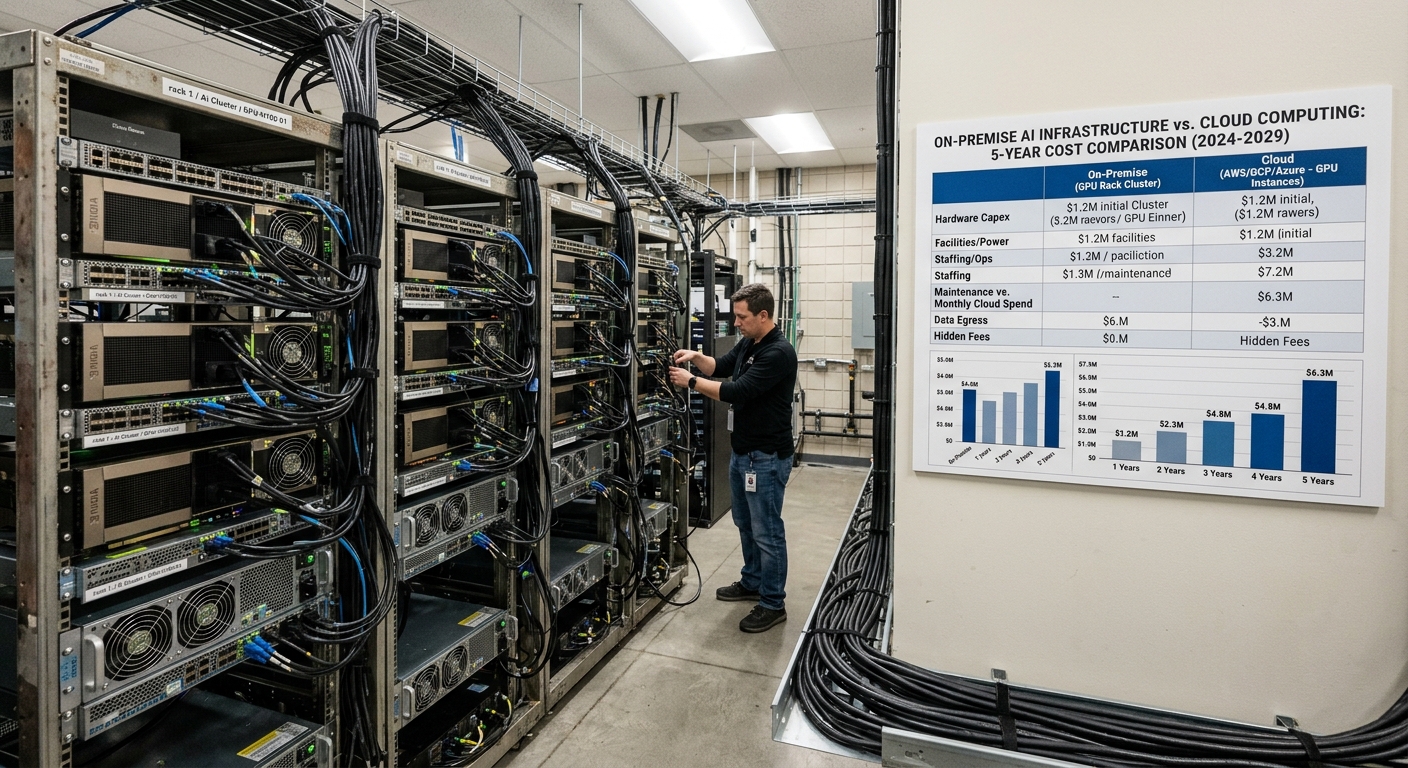
On-Premise AI vs Cloud AI: Total Cost of Ownership Analysis
Key Takeaways
- On-premise AI infrastructure breaks even with cloud in under 4 months for sustained high-utilization workloads, according to Lenovo's 2026 TCO analysis.
- A single 8-GPU server saves over $5 million over 5 years compared to equivalent cloud IaaS spending.
- Cloud APIs win for low-volume usage below 5 million tokens per month. Self-hosted wins above 60 million tokens monthly.
- Per-token costs on owned infrastructure run 8 to 18 times lower than cloud APIs at scale.
The Cost Question in 2026
The debate between on-premise AI and cloud AI is no longer philosophical. It is a math problem. In 2026, organizations can build on-premise AI infrastructure with capital costs starting around $280,000 for an 8-GPU server, or rent equivalent capacity for $90 to $140 per hour from hyperscalers. The crossover point has moved dramatically as GPU hardware prices stabilize and utilization patterns become predictable.
Lenovo's 2026 TCO analysis shows that on-premises infrastructure achieves breakeven in under 4 months for high-utilization workloads, a significant compression from the 12 to 18 month cycles that buyers expected in 2024. This shift makes on-premise AI a financial decision rather than just a compliance or privacy decision.
Who Should Read This
This analysis matters most for teams evaluating their AI infrastructure strategy. If you process millions of tokens daily, the numbers matter. If you use AI sporadically, cloud is fine. The threshold between these two cases is what we are exploring here.
How the Math Works
Total cost of ownership includes everything: hardware, power, cooling, colocation, maintenance, and depreciation for on-premise. For cloud, it includes hourly instance rates, data egress fees, and any managed service markups. Most analyses exclude secondary costs on one side to make their preferred option look better. We include all major categories.
Cloud AI Costs: Per-Token Pricing at Scale
Cloud AI runs on a pay-per-token model that scales linearly with usage. In 2026, frontier model pricing sits between $1 and $15 per million tokens for input, with output tokens typically priced higher. At low volume this is economical. At scale it becomes a five-figure monthly bill.
According to SitePoint's 2026 pricing analysis, processing 50 million tokens per day through OpenAI's GPT-4.1 costs approximately $126,000 per month. Anthropic's Claude Sonnet 4.6 runs about $180,000 per month for the same volume. Open-weight hosted APIs from providers like Together.ai and Fireworks.ai undercut these significantly, running roughly $36,000 per month for 50 million tokens per day.
The Cloud Cost Curve
The cloud cost structure has one defining characteristic: there is no declining cost curve as you amortize hardware. Every month costs roughly the same proportional amount regardless of how long you have been running the service. This makes cloud spending highly predictable but also means there is no efficiency payoff over time for sustained workloads.
Prompt caching and batch processing can reduce effective rates by 30 to 50 percent for workloads with high repetition patterns. However, these savings depend heavily on your specific usage patterns, and many teams overestimate their cache hit rates in practice.
Hidden Cloud Costs
The published API rates tell only part of the story. Data egress fees, storage costs, retry overhead, and payload inefficiencies add an estimated 5 to 15 percent to the raw token bill depending on provider and workload. Organizations without mature FinOps practices routinely overspend by 30 to 40 percent against optimized baselines, effectively paying a capability tax on their cloud deployment.
On-Premise AI: Upfront Capital, Long-Term Savings
On-premise AI infrastructure requires significant upfront investment but delivers dramatically lower per-unit costs once hardware is amortized. An 8-GPU server with H100-class hardware costs approximately $285,000 from major OEMs in 2026, according to Mercatus AI's pricing tracker. The H200 variant runs about $370,000 for the same configuration.
These prices include the GPUs themselves plus server chassis, CPUs, memory, NVLink fabric, networking, and integration. The deployed cost per GPU lands near $36,000 for H100 systems versus $25,000 to $30,000 for the card alone, because the supporting infrastructure adds $70,000 to $90,000 to the total bill.
Operational Expenses
Running owned infrastructure involves ongoing costs that get undercounted in optimistic analyses. At minimum you need to budget for electricity at roughly $0.12 per kWh, cooling overhead, colocation at $1,500 per rack monthly for high-density power, and maintenance contracts running 12 percent of system cost annually.
A single 8-GPU H100 server draws approximately 10 kW at full load. At 70 percent average utilization, that translates to roughly $7,500 per year in power costs assuming typical US commercial electricity rates. Colocation adds another $18,000 annually for a high-density rack.
Depreciation and Resale
GPU hardware depreciates over a 3 to 5 year lifecycle, but the H100 has one economic advantage over newer generations: a functioning secondary market. Refurbished H100 cards trade at $18,000 to $22,000 in 2026, with mid-case retained value at 36 months running 50 to 60 percent of original card price. This resale value can reduce effective ownership cost by $50,000 to $150,000 per server over three years.
The Breakeven Calculation
The breakeven point is where the cumulative cost of cloud infrastructure matches the total investment in on-premise infrastructure. The calculation depends on three primary variables: hardware cost, cloud pricing tier, and utilization rate.
Lenovo's analysis models an 8-GPU H100 server against Azure's on-demand ND96isr H100 v5 instance at $98.32 per hour. The breakeven arrives at approximately 2,720 hours of continuous use, which is roughly 35 days of 24/7 operation. With a 3-year reserved cloud instance at $39.32 per hour, the breakeven stretches to 7,591 hours, or about 102 days.
The Utilization Threshold
A more practical question is the daily utilization threshold. Using Lenovo's Config B (8x H200) against Google Cloud's on-demand rate of $84.81 per hour, owning becomes cheaper than renting when the system runs just 4.3 hours per day over a 5-year period. This is surprisingly low because cloud on-demand pricing carries such a steep markup.
At 70 percent sustained utilization, owned H100 infrastructure runs approximately $1.56 per GPU-hour all-in at 3-year amortization with mid-case resale. On-demand cloud runs $2.80 to $3.80 per GPU-hour at hyperscalers. The gap widens as utilization increases because idle GPU hours cost the same whether the card processes zero tokens or maximum throughput.
Reserved Cloud Complicates the Picture
Three-year reserved cloud instances at $1.70 to $2.00 per GPU-hour narrow the gap significantly. Against this pricing tier, breakeven stretches to 12 to 18 months at 75 percent utilization. This is the scenario where financing structure and tax treatment decide the project, not just the silicon math.
Token Economics: Cost Per Million Tokens
The industry metric for AI infrastructure efficiency has shifted from FLOPS to tokens per second per dollar. This metric allows direct comparison between buying hardware and buying API access.
According to Lenovo's 2026 analysis, self-hosting a 70B model on an 8-GPU H100 system costs approximately $0.11 per million output tokens when fully amortized over 5 years. The equivalent Azure H100 on-demand instance runs $0.89 per million tokens. That is an 8x cost advantage for owned infrastructure against cloud IaaS.
Comparison with Frontier APIs
The gap widens dramatically when comparing against Model-as-a-Service APIs. GPT-4.1 mini charges approximately $2.00 per million output tokens. The same workload on owned hardware runs $0.11 per million tokens, an 18x difference. At enterprise scale processing billions of tokens monthly, this represents the single largest line item in the AI budget.
At Different Volumes
The advantage scales with volume. Below 5 million tokens per month, cloud APIs are almost always cheaper because hardware costs do not amortize well at low utilization. Between 5 and 60 million tokens monthly, the answer depends on specific usage patterns, model sizes, and internal operational capacity. Above 60 million tokens per month, self-hosted infrastructure is typically cheaper once all costs are accounted for.
According to IDC research cited by Silverthread Labs, organizations processing 100 million tokens monthly can save $5 million to $50 million annually by owning their inference layer.
The 5-Year Lifecycle Comparison
Over a standard 5-year operational lifespan, the cost difference becomes stark. Lenovo's analysis of an 8-GPU B300 server against AWS's equivalent p6-b300.48xlarge instance shows the cloud approach costing $6,238,000 over 5 years at 24/7 operation versus $1,013,447 for the owned system. The savings total $5,224,552, or 83.8 percent.
This comparison uses on-demand cloud pricing. Reserved instances narrow the gap, but the fundamental structure remains the same: variable cloud costs compound over time while fixed on-premise costs decline in per-unit terms as utilization increases.
The Cost Curve Divergence
The on-premise cost curve is front-loaded. Year 1 carries the full hardware investment plus initial operational costs. Years 2 through 5 see dramatically lower costs as infrastructure amortizes. The cloud cost curve is flat, charging the same rate regardless of tenure. Over any time horizon longer than the breakeven point, the two curves diverge steadily.
Hardware Refresh Cycles
GPU generations turn over on a 2 to 3 year cycle. Organizations that fail to model refresh cycles systematically understate their 5-year TCO. A complete plan includes budgeting for one refresh within the 5-year window, typically at months 36 to 48, which adds $200,000 to $400,000 to the total lifecycle cost for an 8-GPU system.
When Cloud Still Wins
On-premise is not universally better. Cloud AI infrastructure wins in several specific scenarios where the economics genuinely favor rental over ownership.
Low Volume and Variable Workloads
Below 500,000 tokens per day, cloud APIs are dramatically cheaper. A consumer-grade local setup costs $3,350 in hardware plus $1,800 in labor for deployment, totaling over $6,000 in the first year. The equivalent cloud API bill for the same volume runs approximately $1,260 per year with OpenAI, less for budget providers.
Experimental and Burst Workloads
Model training, fine-tuning, and research phases involve unpredictable compute needs that burst and then idle. Renting GPU capacity for weeks or months at a time makes more sense than provisioning hardware that sits at 30 percent utilization most of the year. Cloud's elasticity option has real economic value for these patterns.
Teams Without Operational Capacity
A production on-premise deployment requires 10 to 20 hours of DevOps time per month for monitoring, updates, and maintenance. Each major model update requires 1 to 2 weeks of engineering time. At senior engineer rates, this adds $17,000 to $46,000 annually in labor costs that do not appear in hardware pricing comparisons.
The Hybrid Approach
Most enterprises land on a hybrid model that combines the strengths of both approaches. Self-hosted infrastructure handles the baseline high-volume workload at fixed cost, while cloud APIs cover demand spikes, experimental workloads, and access to frontier proprietary models.
In practice this means routing 70 to 85 percent of traffic to local models for routine classification, summarization, and drafting workloads. The remaining 15 to 30 percent routes to cloud frontier models for tasks requiring reasoning, multi-hop analysis, or specialized capabilities that open-weight models cannot match.
Routing Changes the Economics
A workload that costs $50,000 per month running entirely through frontier-model APIs can fall to $8,000 to $15,000 when 70 percent of calls route to smaller local models with quality-equivalent outputs for routine tasks. This routing-aware cost model is the optimal architecture for most enterprise workloads in 2026.
The Decision Framework
The right choice depends on four factors: monthly token volume, usage consistency, compliance requirements, and available operational capacity. Below 5 million tokens monthly with variable usage, cloud wins. Above 60 million tokens monthly with steady demand, on-premise wins. Between these thresholds, a hybrid approach typically delivers the lowest blended cost.
Getting Started: AI on Your Desktop
Enterprise clusters are not for everyone. If your team is small, your workload fits a desktop GPU, or you're just exploring local AI before committing to infrastructure spend — you don't need an 8-GPU server to start benefiting from private AI.
Cowork brings local AI to your desktop without requiring GPU procurement, DevOps teams, or cloud API dependencies. Your data stays on your machine, and the economics are straightforward: you only pay for electricity.
- Zero infrastructure overhead: Run AI on your own hardware. No servers, no clusters, no managed services.
- Eliminate per-token costs: Stop paying API fees for your routine AI workloads. Your local model handles summarization, document analysis, and research at fixed cost.
- Start before you scale: Use Cowork to evaluate local AI benefits today, then decide on enterprise infrastructure based on real usage data.
Cowork — private AI on your desktop
Frequently Asked Questions
At what volume does on-premise AI become cheaper than cloud?
The breakeven typically falls between 60 million and 100 million tokens per month for sustained workloads. Below this threshold, cloud APIs remain more economical once you account for hardware depreciation, operational overhead, and engineering time required to maintain self-hosted infrastructure.
How much does an 8-GPU AI server cost in 2026?
An 8-GPU H100 server runs approximately $285,000 from major OEMs including server hardware, networking, and integration. H200 systems cost about $370,000. The per-GPU deployed cost is $36,000 for H100 and $46,000 for H200, significantly higher than standalone card prices because supporting infrastructure adds substantial cost.
What are the ongoing operational costs of on-premise AI?
Expect approximately $12.50 per server-hour all-in at 70 percent utilization over a 3-year horizon. This includes amortized hardware, power, colocation, maintenance contracts, and operational labor. Resale value at the end of the depreciation period can reduce these costs by 20 to 30 percent for hardware with active secondary markets.
Is cloud AI still better for small teams?
Yes. For teams processing less than 5 million tokens monthly, cloud APIs are almost always cheaper. The engineering time required to deploy and maintain on-premise infrastructure alone costs more than the API bill at low volumes. Cloud wins on deployment speed, frontier model access, and cost at low or variable volume.
Can you mix cloud and on-premise AI?
Hybrid deployment is increasingly the optimal pattern. Self-hosted infrastructure handles predictable high-volume workloads at fixed cost while cloud APIs cover burst demand, experimental workloads, and specialized tasks. Policy-based routing between local and cloud models typically delivers the lowest blended cost for enterprise workloads with mixed task profiles.