Local AI Models vs Cloud Performance Comparison 2026
Real benchmarks comparing Qwen, Llama, and Mistral local models against cloud APIs. When does local AI match cloud performance, and when should you stick with the API?
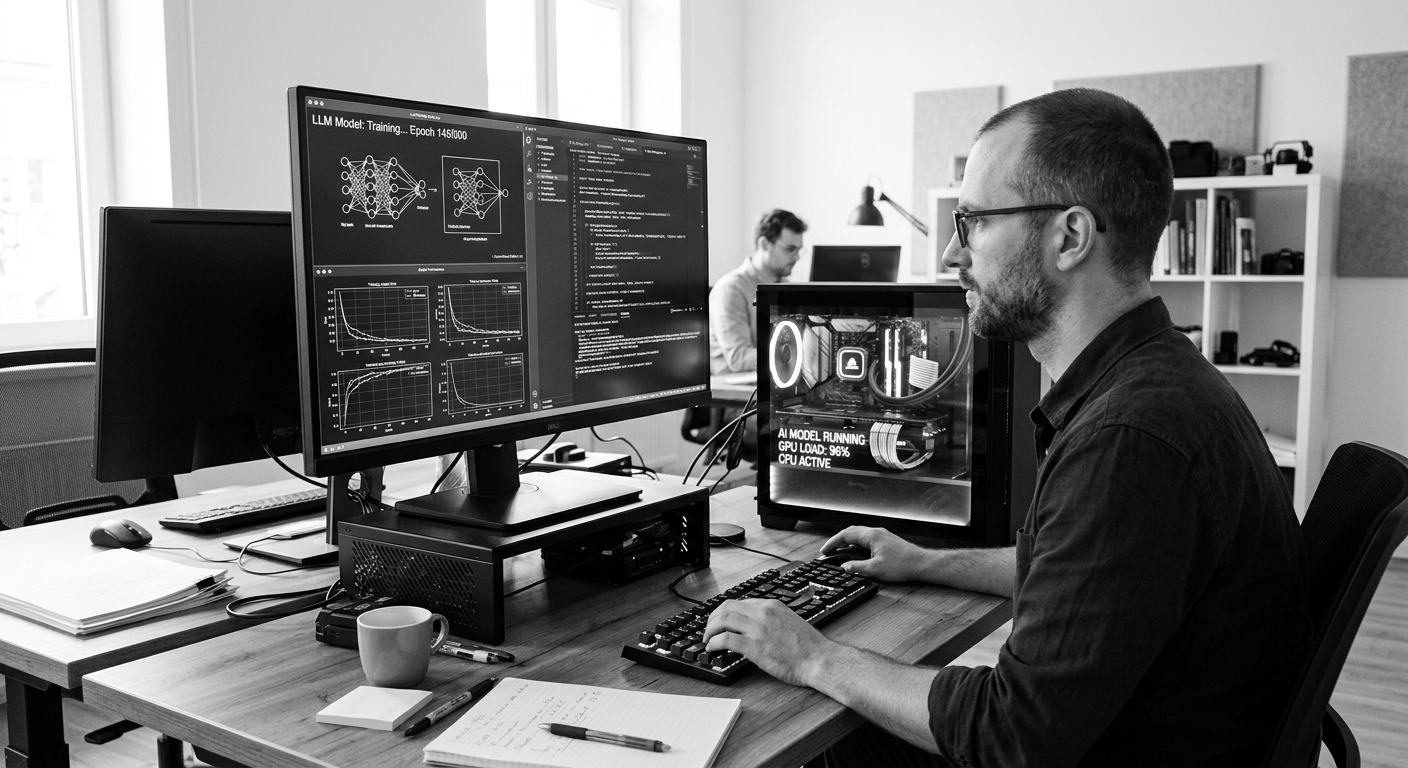
Local AI Models vs Cloud Performance Comparison 2026
Key Takeaways
- Local models hit the first token in 0.1 to 0.3 seconds. Cloud APIs take 0.8 to 1.2 seconds because of network round trips.
- Qwen 3.6 27B scores 77.2% on SWE-bench, rivaling what frontier cloud models delivered just a year ago.
- For coding and everyday writing, local AI covers 80 to 90% of professional tasks at a fraction of the cost.
- Cloud still wins on the hardest reasoning, complex multimodal work, and anything requiring the absolute latest model weights.
The honest state of local AI in 2026
Local AI is no longer a fringe experiment. A single used GPU can now run models that handle professional coding, document analysis, and structured reasoning tasks. The open-weight frontier trails closed models by roughly a few months, not a year, and that gap keeps shrinking.
The question is no longer whether local AI is viable. It is settled. The real question is which workloads actually need cloud and which ones can live on your desk.
Quality at a glance
In practice, a Qwen 3.6 27B model running on an RTX 4090 produces professional-grade code generation, debugging, and test writing. On everyday writing tasks like emails, reports, and summaries, the quality difference from GPT-5.5 or Claude Sonnet 4.5 is often minimal. For the hardest reasoning and architecture tasks, cloud models still have a real edge.
Speed depends on your model
A local RTX 4090 running a 7B model delivers 80 to 120 tokens per second, which is faster than most cloud APIs. The same card running a 27B model drops to 20 to 35 tokens per second. Apple Silicon M4 Pro machines hit similar numbers for the 27B class. For CPU-only setups, expect 3 to 8 tokens per second, which is functional but slow.
| Configuration | Typical Speed |
|---|---|
| Cloud (GPT-5.5, Claude) | 50 to 100 tok/s |
| RTX 4090 (7B) | 80 to 120 tok/s |
| RTX 4090 (27B) | 20 to 35 tok/s |
| Apple M4 Pro (27B) | 25 to 35 tok/s |
| CPU only (7B) | 3 to 8 tok/s |
Latency is where local wins
Cloud APIs add network overhead before the first token appears. Local models start generating almost instantly. For interactive work like chatting with a codebase, that half-second difference is noticeable.
Benchmark deep dive: Qwen, Llama, Mistral
The three model families that dominate local AI in 2026 each optimize for something different.
Qwen 3.6 — the coding leader
Qwen 3.6 27B hits 77.2% on SWE-bench, placing it alongside frontier cloud performance from just a year ago. The MoE variant, Qwen 3.6-35B-A3B, activates only 3B parameters per token and scores 73.4% on SWE-bench Verified while running at 100+ tokens per second on a single RTX 3090. Alibaba also ships a 397B flagship scoring 76.4% on SWE-bench Verified and 77.2% on GPQA Diamond for graduate-level science questions.
When we tested Qwen 3.6 27B against Claude Sonnet on real debugging tasks, both models found the same bugs. Qwen was slower on total generation time, but the output was functionally identical for anything short of multi-file architectural refactoring.
Llama 4 Scout — the long-context option
Meta's Llama 4 Scout supports a 10-million-token context window. No cloud model currently matches this. For processing entire codebases, year-long email histories, or full document libraries in a single context, local Llama 4 Scout has an absolute advantage. The Llama 3.3 70B scores 86% on MMLU and 92.1% on IFEval for instruction following, making it the best pick for general-purpose chat if you have 48GB+ of VRAM.
Mistral Small 3.2 — the efficiency pick
Mistral Small 3.2 at 24B parameters fits on a 16GB GPU and still hits 92.9% on HumanEval for code generation, outperforming Llama 3.3 70B on that benchmark despite having 46B fewer parameters. It also leads on European language support. At roughly 13.4GB at Q4 quantization, it runs comfortably on an RTX 4060 Ti or RTX 5060 Ti.
Cost comparison: hardware vs recurring API bills
Cloud API pricing
Cloud providers charge per token. GPT-4o runs roughly $2.50 per million input tokens and $10.00 per million output tokens. Claude 3.5 Sonnet is roughly $3.00 in and $15.00 out. For a developer making hundreds of requests daily, these costs compound quickly into $50 to $100 per month or more.
Local AI cost
After buying the hardware, you only pay for electricity. A GPU drawing 150W during inference costs roughly 1.5 cents per hour at standard US rates. Eight hours of daily coding-assistant use runs about $3.60 per month. Over a year, that is roughly $43 in electricity. A $300 GPU breaks even against cloud API pricing at around 3.5 million tokens of monthly generation, well within the range of an active developer.
The break-even math
Light users generating fewer than 15K output tokens daily are better off with cloud APIs. Steady users who send prompts throughout the day save money on local AI within weeks. If two developers share the rig, break-even happens in months not quarters.
When local AI wins
Privacy and data control
This is the strongest argument for local AI. When you run a model on your own machine, Anthropic, OpenAI, Google, Meta, and Chinese AI labs cannot see your data because the model runs locally. You can share almost anything with zero risk. For legal, medical, financial, and sensitive business use, local AI is the only option that provides genuine control.
Offline availability
A model sitting on your disk cannot be revoked. In June 2026, a US export-control directive forced Anthropic to disable Claude Fable 5 and Mythos 5 for foreign nationals. People who depended on those models lost access overnight. A local model keeps working regardless of policy changes, pricing shifts, or vendor decisions.
No rate limits
Cloud APIs impose rate limits that vary by plan and model. Local models respond whenever you need them, as many times as you need them. There is no throttling during peak hours and no surprise billing when a runaway prompt chain hits your monthly cap.
When cloud AI still wins
Frontier reasoning
GPT-5.5 and Claude Opus 4.5 are trained on orders of magnitude more data and compute than any publicly available local model. On the hardest mathematical proofs, competition-level algorithm problems, and cutting-edge research analysis, the gap is real and noticeable.
Multimodal tasks
Cloud AI handles image generation, video analysis, and advanced voice interaction at a level local models cannot match. Local vision models like Gemma 4 9B and Llama 3.2 Vision handle basic image analysis and document understanding. For anything involving voice, video, or complex visual reasoning, cloud AI is substantially ahead.
Complex multi-file refactoring
Cloud frontier models handle architecture-level decisions across dozens of files better than any local model currently available. Qwen 3.6 27B manages most coding tasks well, but stepping into system-wide refactoring exposes the training-scale gap.
Hybrid approach: the pragmatic answer
Most developers and teams do not need to pick one side. The pattern that works in practice is straightforward.
Use local AI for the 60 to 70% of tasks that are routine: code generation, debugging, test writing, summarization, document classification, and structured data extraction. Use cloud APIs for the 30 to 40% that genuinely need frontier capability: complex architecture decisions, competitive programming, and novel reasoning problems.
This hybrid approach cuts monthly costs from $50 to $100 down to $5 to $15 while maintaining quality where it matters.
How Zosma Helps with Local AI
Zosma's Cowork addresses the biggest barrier to local AI: making it simple enough that anyone can run powerful models on their own machine without cloud dependencies.
- Local-first architecture: Models run entirely on your PC. Anthropic, OpenAI, Google, and Meta cannot see your data because it never leaves your machine.
- Plain-English AI interaction: No prompt engineering required. Cowork handles document processing, coding assistance, and analysis through natural conversation.
- Unlimited intelligence for learning and self-improvement: You only pay for electricity. No token limits, no per-query billing, no surprise charges.
- Private data handling: Share proprietary code, financial documents, or sensitive materials without any risk of third-party data collection.
Frequently Asked Questions
Is local AI as good as cloud AI?
For 80 to 90% of professional tasks, yes. Local models like Qwen 3.6 27B and Llama 4 Scout produce professional-quality output for writing, coding, debugging, and analysis. Cloud models maintain a real advantage only on the hardest reasoning tasks, frontier mathematics, and complex multimodal work.
What GPU do I need for local AI?
An RTX 3060 with 12GB VRAM runs 7B to 8B models like Qwen 3 at full quality. An RTX 3090 or 4090 with 24GB handles 27B to 35B models. For 70B models you need 48GB+ of VRAM or an Apple Silicon Mac with 64GB or more unified memory.
How much does local AI cost?
After buying hardware, you only pay for electricity. A typical GPU drawing 150W during inference costs about 1.5 cents per hour. Eight hours of daily use runs roughly $3.60 per month in electricity costs.
Can local AI handle sensitive data?
Yes, this is actually the strongest advantage of local AI. When models run on your own machine, your prompts and documents never leave it. Anthropic, OpenAI, Google, and Meta cannot see your data. No third party logs or stores it, and there is no legal discovery risk.
When should I still use cloud AI?
For light or occasional use, cloud APIs are cheaper since you avoid hardware costs. Cloud also wins on frontier reasoning tasks, complex multimodal work, and any workload where the absolute latest model weights matter more than privacy or cost.