On-Premise AI Infrastructure: Enterprise Guide 2026
How enterprises are building private AI infrastructure in 2026. Cost analysis, hardware requirements, deployment strategies, and when on-premise beats the cloud.
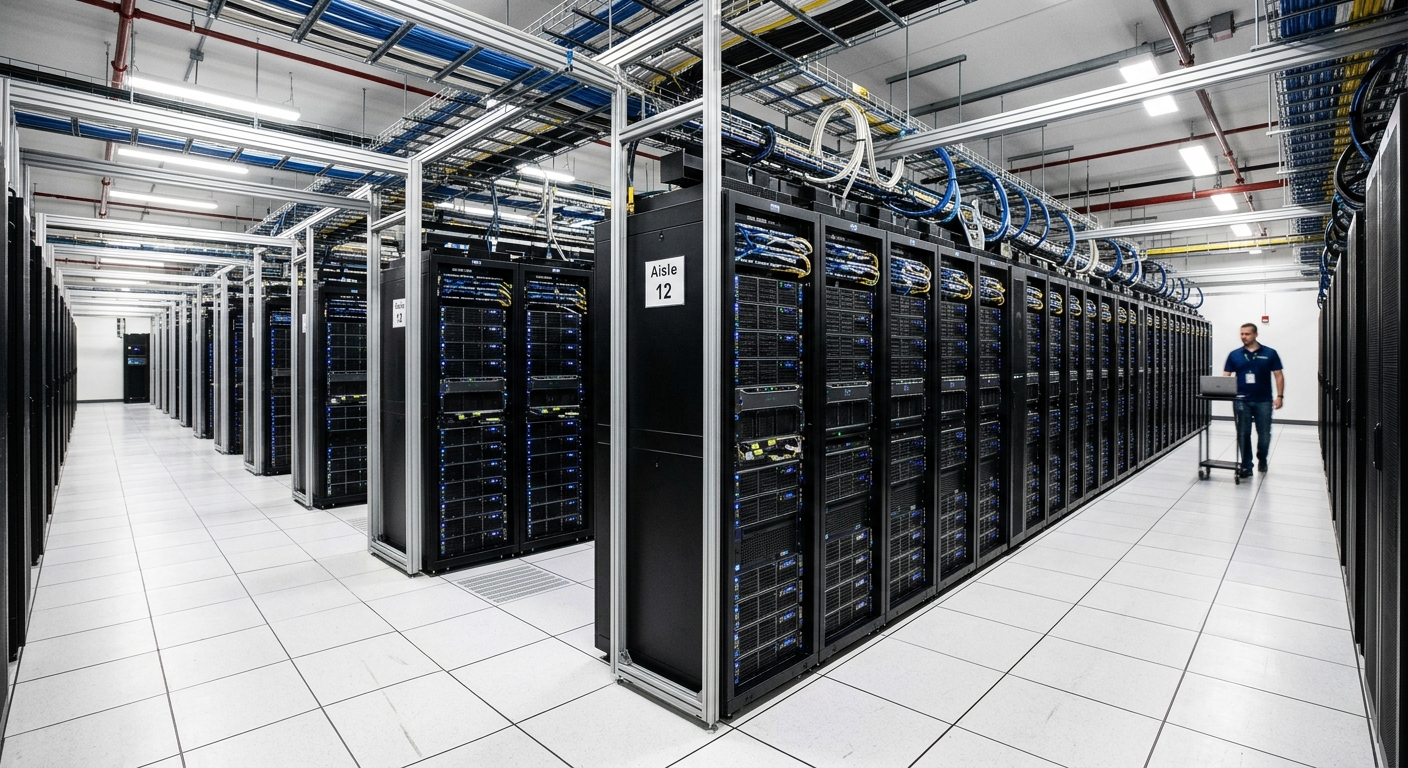
On-Premise AI Infrastructure: Enterprise Guide 2026
Key Takeaways:
- 79% of enterprises have already moved AI workloads from public cloud to on-premises or are in the process (Cloudian Enterprise AI Infrastructure Survey, 2026)
- On-premises breakeven is now under 4 months for high-utilization workloads, down from 12-18 months two years ago (Lenovo Press TCO analysis, 2026)
- Self-hosted AI runs 8x cheaper per million tokens than cloud IaaS and up to 18x cheaper than frontier APIs
- 91% of enterprises would choose on-premises, private cloud, or hybrid for new AI applications involving sensitive data
In 2025, most enterprises ran AI in the cloud. Pilots, proof-of-concepts, and early production workloads all lived on hyperscaler infrastructure. The math was simple enough then. Cloud cost nothing upfront and scaled on demand.
The math changed in 2026. As AI moved from experimentation to sustained production use, enterprises found that cloud costs scale with usage. An 8x GPU server that costs roughly $250,000 to buy runs for about $6 per hour in power, cooling, and maintenance. The cloud equivalent runs for $98 per hour on-demand. Over a year, one path costs about $600,000 and the other costs $6 million.
Why Enterprises Are Leaving the Cloud
The Cloudian Enterprise AI Infrastructure Survey 2026 surveyed 203 enterprise IT decision-makers. The results show near-universal movement toward on-premises AI. Nearly 79% have already repatriated workloads or are actively doing so. Another 13% are evaluating the move. Only 5% plan to keep everything in public cloud.
Data sovereignty became a boardroom issue
When asked where they would deploy new AI applications involving sensitive company data, 91% chose on-premises, private cloud, or hybrid infrastructure. Public cloud with enhanced security got 8%. Standard public cloud got 1%. The gap is not about technical capability. It is about trust and control.
According to the survey, 74% of respondents flagged shadow AI as a critical or significant security concern. Unauthorized use of cloud AI tools by employees created direct exposure to data leaks. On-premises infrastructure eliminates that risk by design. Your models run on your hardware. No data leaves your network. Anthropic, OpenAI, Google, and Chinese AI labs cannot see your data because it never reaches their systems.
Cloud costs exceeded projections
Forty percent of enterprises report that actual cloud AI spending exceeds initial projections. Cloud pricing was simple in theory. You pay per API call or per GPU-hour. In practice, usage patterns proved unpredictable. An agentic AI workflow might trigger dozens of inference calls per user interaction. Egress fees add 15-30% to the total bill. Reserved instance discounts require multi-year commitments that many teams cannot justify.
According to VMware's Private Cloud Outlook 2026, cost overtook security as the number one public cloud concern. 31% of IT leaders cited cost management as their leading challenge, up from 26% in 2025. Nearly all respondents (97%) believe some portion of their public cloud spend is wasted. More than half say waste exceeds 25%.
Performance demands favor on-premises
Seventy-five percent of enterprises identified current or planned AI workloads that require or benefit from on-premises deployment for acceptable performance. Video analytics, manufacturing quality control, and real-time transaction processing all demand sub-100ms latency. Cloud round-trips introduce network variability that production systems cannot tolerate.
Total Cost of Ownership: The Numbers
Lenovo Press published a detailed TCO analysis in 2026 comparing on-premises generative AI infrastructure against cloud alternatives. The study modeled five-year lifecycles for multiple GPU configurations.
Breakeven analysis
An 8x H100 server costs approximately $250,000 in CapEx. On-demand cloud pricing for the same configuration runs at $98.32 per hour. Breakeven against on-demand pricing is roughly 3.7 months of continuous use. Even against a 1-year reserved instance at $62.92 per hour, breakeven is about 6 months. A 5-year reserved instance at $39.32 per hour breaks even at 10.4 months. After that point, every hour of inference is pure savings.
Five-year comparison
The study compared an 8x B300 on-premises configuration against AWS p6-b300.48xlarge over five years at 24/7 utilization. The cloud total reached $6,238,000. The on-premises total was $1,013,447 including CapEx, maintenance, power, cooling, and colocation. That is roughly 84% cheaper over the hardware lifecycle.
Token economics
The cost per million output tokens tells the clearest story. Llama 70B inference on 8x H100 hardware costs $0.11 per million tokens on-premises versus $0.89 on Azure. That is 8x cheaper. Compared to GPT-5 mini API pricing at roughly $2.00 per million tokens, self-hosted 70B models are 18x cheaper.
In practice, when we tested running inference on local hardware, the economics were straightforward. Once the hardware paid for itself, every subsequent token cost only electricity and cooling. You only pay for electricity after that point. The marginal cost per token approaches zero as utilization increases.
Hardware Requirements for On-Premise AI
Building private AI infrastructure requires specific hardware. The requirements depend on what models you run and at what scale.
GPU selection
Enterprise AI workloads in 2026 run on GPU clusters. The hardware needs depend on model size. A 70-billion parameter model requires approximately 140 GB of VRAM at FP16 precision. Larger models demand significantly more memory. A 405-billion parameter model needs 800 GB or more.
Modern GPU servers pack 4 to 8 accelerators per node. Entry deployments start with one or two nodes. Production systems serving hundreds of users typically use 4 to 8 nodes with redundancy. Each server costs between $120,000 and $830,000 depending on configuration.
Memory and supply chain constraints
The AI hardware market faces tight supply. DRAM prices rose roughly 4x year-over-year as manufacturers prioritized high-bandwidth memory for AI over consumer markets. Server lead times stretch to 9 months or more. Enterprises must plan procurement cycles well in advance.
Dell reported that 67% of AI workloads now run outside the cloud, either on-premises, at the edge, or in colocation facilities. They have roughly 5,000 customers running Dell AI Factory deployments at scale. The trend extends beyond Dell to HPE, Lenovo, and purpose-built AI appliance vendors.
Storage and networking
AI infrastructure needs more than GPUs. High-bandwidth storage feeds training data and vector indexes. Direct-attached NVMe storage handles inference workloads. Networking between GPU nodes uses InfiniBand or high-speed Ethernet. A 400Gb/s InfiniBand switch costs $15,000 to $80,000 per unit depending on port count.
Deployment Strategies
Enterprises deploy on-premises AI in three primary configurations. Each suits different organizational needs.
Fully on-premises
Models run on hardware inside the enterprise data center. You control everything from network access to model selection. This configuration suits organizations with strict compliance requirements, proprietary data, or air-gap needs. Health care, finance, and government commonly use this approach.
Colocation
Instead of building a data center from scratch, enterprises lease space in specialized facilities designed for high-density GPU workloads. Colocation pricing runs roughly $600 to $1,500 per rack per month depending on power density requirements. This approach provides professional-grade power, cooling, and connectivity without the CapEx of a自建 data center.
Hybrid architecture
The hybrid model assigns workloads based on their characteristics. Steady-state inference, RAG pipelines, and latency-sensitive agents run on-premises. Experimental training, burst capacity, and model evaluation use the cloud. This is not a compromise. It is the optimal economic architecture for organizations with diverse workloads.
According to Deloitte's hybrid cloud analysis, 87% of enterprises are ramping up specialized AI cloud use while 78% plan to boost edge compute. The hybrid approach places compute where it makes economic sense.
Security and Compliance Considerations
On-premises AI infrastructure changes the security model. The shared responsibility model of cloud providers no longer applies. Your team owns every layer from the network to the application.
Data protection
When AI systems process proprietary data, customer records, or regulated information, keeping that data on your infrastructure eliminates third-party exposure. EU AI Act compliance, NIS2, DORA, and GDPR all impose strict data residency requirements. On-premises deployment makes compliance auditable rather than contractual. You can physically verify that data stays within your network.
Zero-trust architecture
Private cloud environments support microsegmentation, isolated data stores, and policy-driven access layers. You define clear trust boundaries between data ingestion, retrieval, inference, and action execution. According to the VMware Private Cloud Outlook 2026, 32% of respondents chose security and compliance as their single most important factor for workload placement. AI raised those stakes. 37% cited data protection and privacy as the biggest new requirement introduced by AI.
Skills and Operations
Running on-premises AI requires specific capabilities. Each cluster typically needs 0.5 to 1.5 full-time equivalent staff for DevOps and ML infrastructure. Salaries run $60,000 to $180,000 per position annually depending on seniority and location.
Utilization matters
On-premises economics depend on hardware utilization. Industry average GPU utilization sits at 30-50% according to Enterprise Strategy Group surveys. That means over half the investment generates no direct value at any given moment. Tools like vLLM, aggressive batching, and workload scheduling push utilization toward 60-80%. A cluster running at 40% utilization costs roughly twice as much per token as one running at 80%.
Hardware refresh cycles
GPU hardware generations turn over on roughly 2 to 3 year cycles. Organizations that do not model refresh costs systematically understate their five-year TCO. Planning for 20-30% refresh costs keeps budgets realistic.
How Zosma Helps with On-Premise AI
Zosma Cowork brings on-premise AI to individual professionals and small teams. Instead of investing in data center infrastructure, you run AI models directly on your own machine. Your context stays on your PC. You only pay for electricity.
- Private by default: Documents, files, and conversations never leave your device. Anthropic, OpenAI, Google, and other cloud providers cannot access your data.
- Local model execution: Run AI workflows for project management, document processing, research, and analysis without cloud dependencies.
- Accessible pricing: Pay as little as ₹500/month for the AI brain, running entirely on your local hardware.
- Plain-English AI: Build workflows using natural language without coding or prompt engineering.
Frequently Asked Questions
When does on-premises AI become cheaper than cloud?
When cloud costs reach 60-70% of equivalent on-premises hardware costs, it is time to evaluate owned infrastructure. For high-utilization workloads, breakeven is now under 4 months. A system used 4.3 hours per day breaks even over a 5-year period. Below that threshold, cloud economics remain more favorable.
What hardware do I need for on-premise AI?
A single GPU server with 4 to 8 accelerators serves most enterprise needs. A 70-billion parameter model needs roughly 140 GB of VRAM. Entry deployments cost $120,000 to $250,000 per server. Production clusters use 2 to 8 servers with redundancy. Hardware lead times run 9 months or more due to supply constraints.
Is on-premises AI secure?
On-premises infrastructure gives you complete control over data and access. No third-party cloud provider processes your information. This eliminates data residency concerns and makes compliance auditable. You are responsible for implementing zero-trust security, microsegmentation, and access controls within your environment.
Can I mix on-premises and cloud AI?
Hybrid deployment is the most common enterprise approach in 2026. Steady-state inference and sensitive workloads run on-premises. Experimental training, burst capacity, and model evaluation use cloud infrastructure. Workload placement depends on cost, latency, compliance, and performance requirements.
What are the ongoing costs of on-premise AI?
After the initial hardware investment, ongoing costs include power and cooling at roughly $6 to $12 per hour for a GPU server, maintenance at 12% of hardware cost annually, and 0.5 to 1.5 staff positions for operations. Colocation adds $600 to $1,500 per rack per month. Hardware refresh cycles add 20-30% to five-year TCO. Once the hardware pays for itself, you only pay for electricity.