AI Agents for Small Business: Local Automation Guide
How small businesses can use local AI agents to automate marketing, accounting, customer service, and operations without cloud APIs.
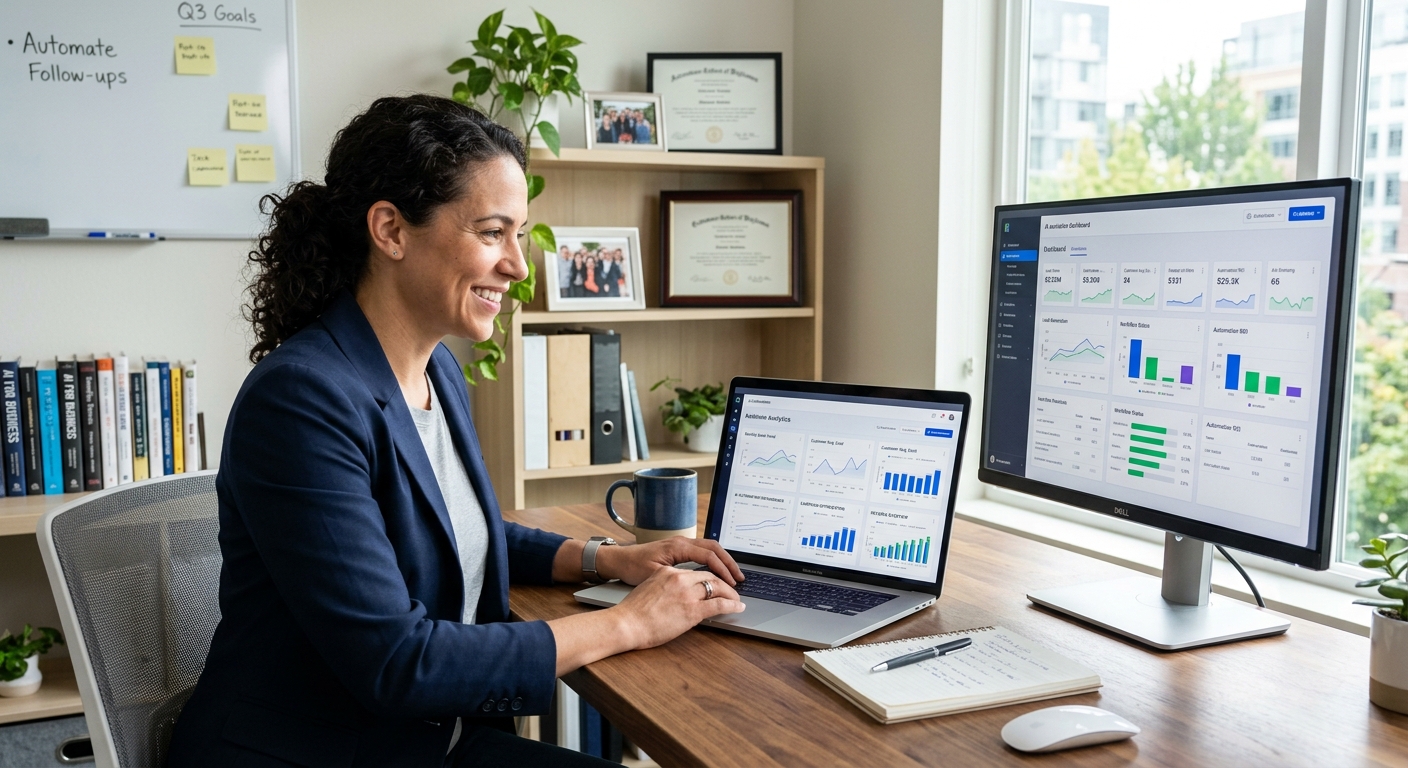
AI Agents for Small Business: Local Automation Guide
Key Takeaways
- 61% of small businesses are actively using AI, up from under half in mid-2024, but only about 10% have invested in dedicated AI tools.
- Businesses using AI automation report 35% lower operational costs and 250% average ROI within 18 months.
- Data privacy remains the number one barrier (36%), which is exactly why local AI that never leaves your machine is the smarter play for small businesses.
- The gap between early AI adopters and everyone else is widening fast. By 2027, 93% of SMBs are expected to run AI in at least one function.
Why Small Businesses Are Adopting AI at Record Speed
AI adoption among small and medium businesses has moved past the experimental phase. According to Intuit's 2026 AI Impact Report based on over 34,000 survey responses, roughly 7 in 10 small businesses across the US, Canada, the UK, and Australia now use AI regularly. In the US alone, regular AI use jumped from 48% in July 2024 to 77% by January 2026.
The businesses actually paying for AI are the ones seeing real results. A Pax8 survey of 402 US small business leaders found that 68% of AI users are confident AI is delivering measurable value. Meanwhile, 71% of AI users say AI gives small businesses the ability to compete with larger companies.
The data is clear. Small businesses using AI are not just keeping pace. They are pulling ahead.
What Drives Adoption
The reasons are practical, not theoretical. Saving time, automating repetitive work, and helping employees focus on higher-value tasks. According to the Small Business & Entrepreneurship Council's 2025 survey, 60% of small businesses adopted AI primarily for efficiency, 42% for customer service improvement, and 37% because of competitive pressure.
Cost reduction is real. 91% of AI-using small businesses report some level of cost savings, with a median reduction of 10.7%. Many are reinvesting those savings back into technology upgrades, wage growth, and expanding their teams.
What Slows It Down
Security and privacy concerns remain the single biggest barrier at 23% of SMBs, followed closely by lack of internal expertise at 22% and cost uncertainty at 21%. These are not abstract concerns. Business leaders are describing specific risks like customer data exposed, confidential information processed without safeguards, and employees using the wrong tools.
This is where local AI changes the equation. When your AI runs on your own machine, none of these concerns apply. Your data never touches Anthropic, OpenAI, Google, or any other cloud provider. You can share almost anything with zero risk.
What AI Agents Actually Do for Small Businesses
AI agents are not chatbots. A chatbot waits for a prompt and responds. An agent sees the problem, plans the steps, and executes. If a chatbot tells you stock is low, an AI agent checks historical sales, finds the best supplier price, and drafts the purchase order for your approval.
The most common AI use cases reflect pure pragmatism. According to the Pax8 Q2 2026 survey, data analysis and business intelligence leads at 52% among AI-using businesses, followed by customer service and marketing at 50% each. Operations and logistics follow at 45%, with finance and accounting at 37%.
The Revenue Impact
The numbers are striking. Research from Stealth Agents' 2026 AI Adoption Report shows that 67% of small businesses actively running AI automation saw revenue growth exceeding 20% in the past year, up from 41% in 2023. The businesses that crossed from exploring to running AI automation are seeing compounding returns.
Businesses that started automating in 2024 are now on their fourth or fifth workflow. Those starting now are on their first. That gap compounds every quarter.
Where Small Businesses Use AI Most
The Simply Business 2026 survey of 1,047 US small business owners shows the most-used applications are research and brainstorming at 51%, content creation at 44%, and visual design at 37%. Beyond creative work, 31% use AI for financial management and bookkeeping, 25% for code generation and IT tasks, and 22% for supply chain and logistics.
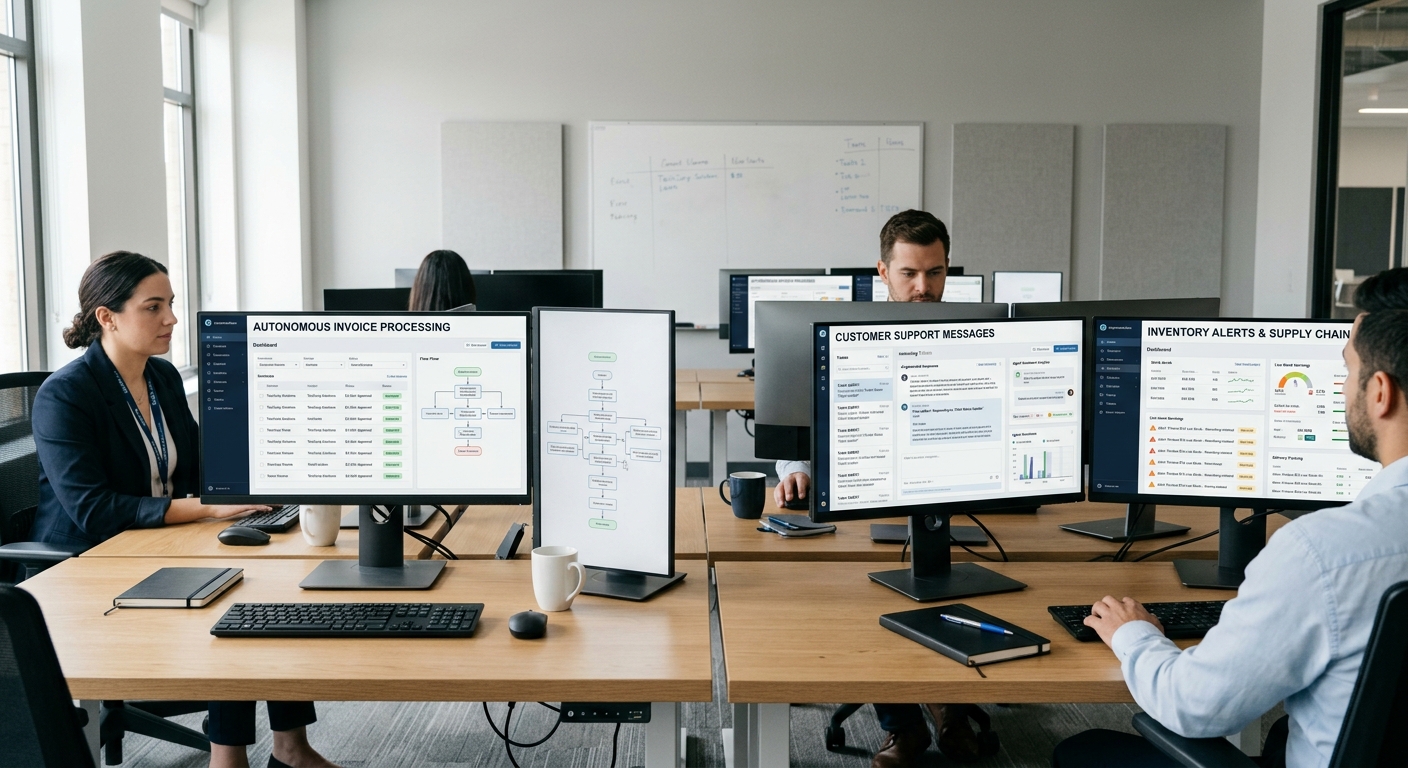
The pattern is consistent. AI shows up first where the busywork is. Admin, customer communication, scheduling, and repetitive data tasks. That is where the early wins are, and where automation delivers the fastest return.
Why Local AI Matters More for Small Business
Here is the thing most AI discussions skip. When you use cloud AI tools, your business data goes to someone else's servers. Customer lists, invoices, contracts, and financial records all get processed by Anthropic, OpenAI, Google, Meta, or Chinese AI labs that train on whatever you send them.
For a small business handling customer data, that risk is real and not easily dismissed.
Privacy Without Compromise
Local AI runs on your own hardware. Your context stays on your PC. You only pay for electricity to run it, not per-token fees to a cloud provider. There is no data leakage, no API cost creeping up as your usage grows, and no vendor lock-in.
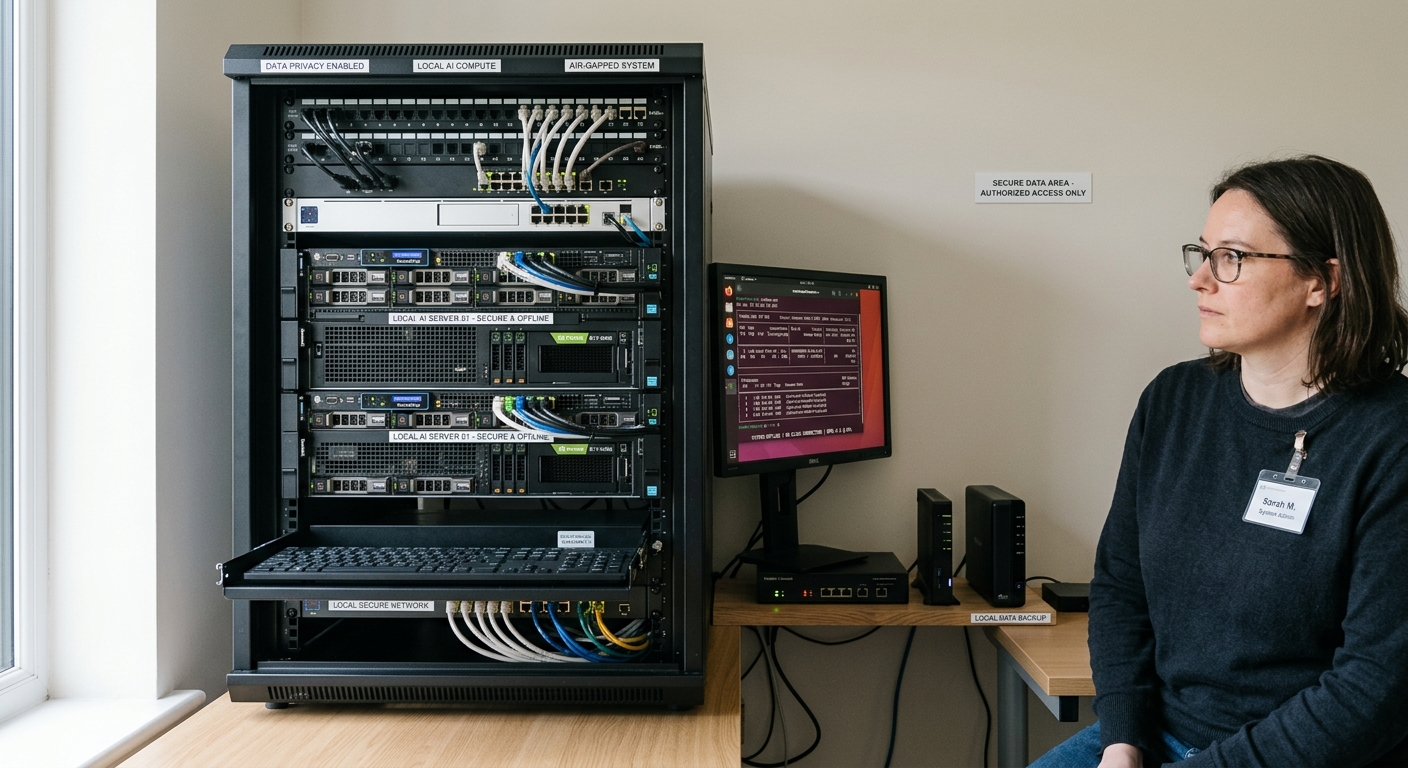
The Google-India SME Forum found that AI could unlock over $490 billion in economic value for India's MSMEs alone, while improving profitability by 30-35%. But a LinkedIn study showed that 95% of Indian SMB decision-makers say platform credibility matters more than cost or convenience. Data security ranks at 83% as a top consideration.
Local AI gives you the capability without the compromise.
Cost Control That Scales
The median annual spend on AI tools for small businesses is $783, according to the SBE Council's 2025 survey, with 73% of firms spending under $5,000. Cloud AI tools charge per token, and those costs compound as usage grows. A business processing hundreds of invoices monthly through a cloud API can easily spend thousands per month.
With local AI, the compute cost is fixed. You buy the hardware once and run indefinitely. For a small business where margins matter, that difference between a variable API bill and a fixed electricity cost is enormous.
How to Start Automating With AI Agents
Getting started with AI agents does not require a data science team or a six-figure budget. The systematic implementations show 2.8x higher ROI than ad hoc approaches, so having a basic plan matters more than having the fanciest tools.
Start With Your Highest-Volume Tasks
The fastest ROI comes from automating tasks that happen every day. Customer service inquiries, invoice processing, inventory tracking, and social media content. These are the workflows where AI agents deliver measurable, repeatable value from day one.
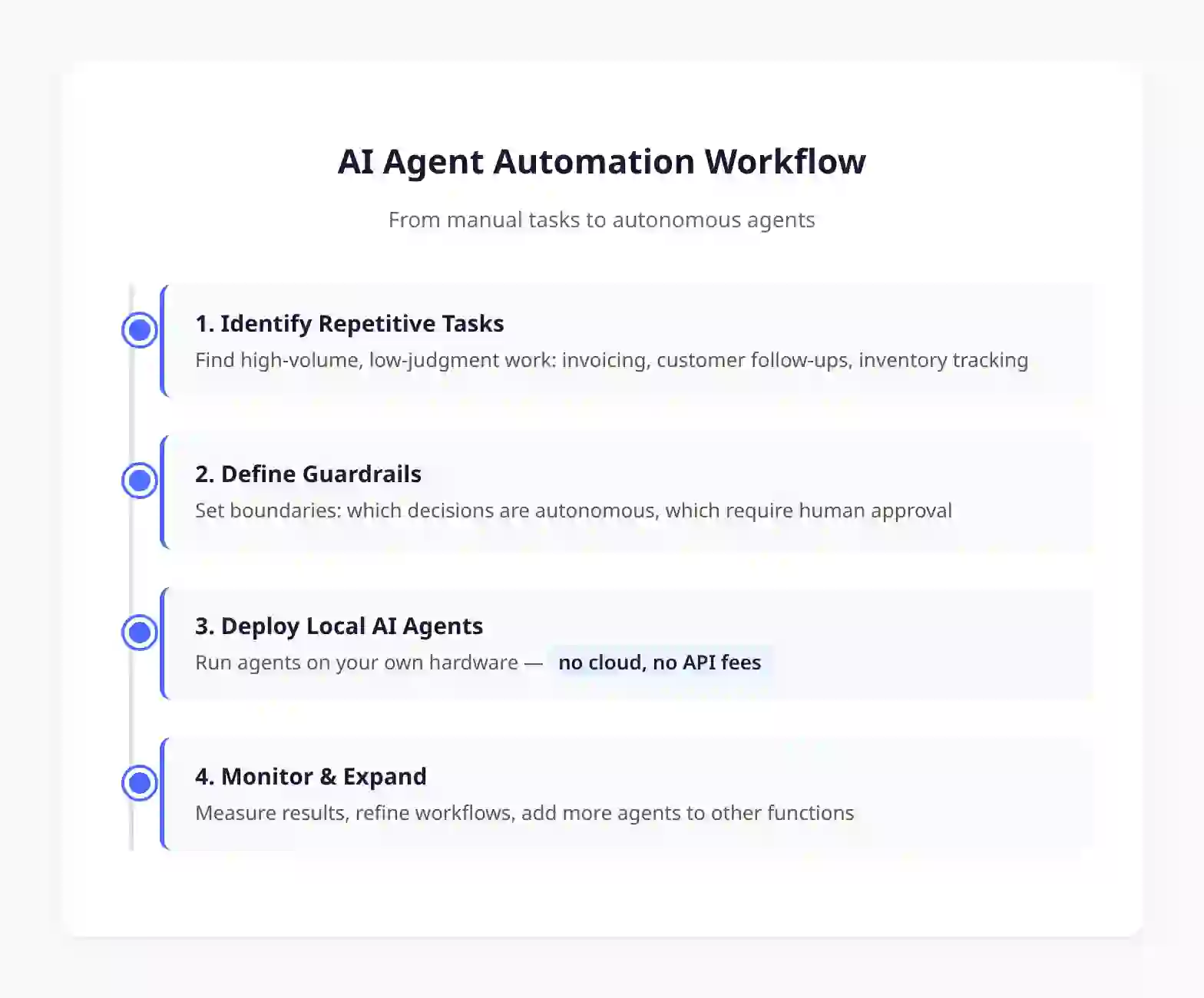
In practice, most small businesses start with one or two workflows and expand from there. A retail store might begin with automated inventory alerts, then add customer service agents, then move into financial reporting. Each automation makes the next one easier because the infrastructure is already in place.
Build Guardrails First
Only 23% of SMBs have a documented AI use policy, according to the Pax8 survey. That gap between adoption and governance is one of the defining management challenges of 2026. For local AI, the guardrails are built in since your data never leaves your control.
The key is deciding which decisions the agent makes autonomously and which require human approval. A customer follow-up email can be fully automated. A supplier purchase order should require review. Setting those boundaries upfront prevents problems before they happen.
The Competitive Gap That Is Opening
The businesses already using AI look fundamentally different from those that are not. According to the Pax8 Q2 2026 data, 65% of AI users describe their organization as proactive on technology decisions, compared with just 33% of non-users. And 31% of AI users say they are ahead of competitors on technology, versus 12% of non-users.
The divergence is self-reinforcing. AI users invest more, plan more deliberately, and grow more confidently. The momentum compounds with every passing quarter.
The 2027 Timeline
Research projects that 93% of SMBs will implement AI in at least one business function by 2027, a 15 percentage point increase from current levels. By then, not using AI will be as noticeable as not having a website in 2018. The question is not whether to adopt AI. It is how fast.
Small businesses that automate one process this quarter will find the next automation easier. The one after that even easier still. The businesses still running everything manually are not standing still. They are falling behind.
How Zosma Helps with Small Business AI Automation
Zosma's Cowork is a free desktop AI harness designed for small businesses that want real automation without handing their data to cloud providers. Your AI runs locally on your own machine, so customer data, financial records, and business operations stay completely private.
- Marketing automation: Generate social media content, email campaigns, and product descriptions using local AI that understands your brand
- Accounting workflows: Process invoices, track expenses, and generate financial reports without cloud APIs
- Customer service agents: Handle bookings, follow-ups, and support inquiries through automated AI workflows
- Operations and inventory: Monitor stock levels, generate alerts, and automate routine administrative tasks
You only pay for electricity. No API fees, no per-token costs, no data sent to third-party servers.
Frequently Asked Questions
Can a small business really run AI locally?
Yes. Local AI has matured to the point where a business owner can deploy AI agents on a standard desktop machine. Tools like Zosma Cowork handle the setup, and you only pay for electricity rather than ongoing API fees. The hardware you need is affordable consumer-grade equipment.
What AI tasks work best for small businesses?
Customer service, data processing, marketing content, scheduling, and invoice automation consistently deliver the fastest and highest returns. These tasks have high volume and clear before-and-after metrics, making it easy to measure whether the AI is actually helping.
Is local AI less capable than cloud AI?
Not for most small business workflows. Local models handle document processing, data analysis, content creation, and customer communication just as well as cloud alternatives. The advantage is your data never leaves your control and you avoid the per-token costs that cloud APIs charge.
How much does it cost to automate with local AI?
You only pay for electricity and the initial hardware investment. There are no monthly API fees or per-token charges. For a typical small business, the total cost is a fraction of what cloud AI tools charge, and the cost stays fixed regardless of how much you use the system.
How long does it take to see results from AI automation?
Businesses report an average ROI of 250% within the first 18 months from AI automation, according to multiple 2026 industry studies. The first workflow usually pays for itself within the first month or two, especially for high-volume tasks like customer service and data processing.