Zosma Cowork for Project Management: Automate Status Updates and Tracking
45% of project managers spend over a day per week manually reporting status. See how AI agents cut that to minutes and keep teams aligned.
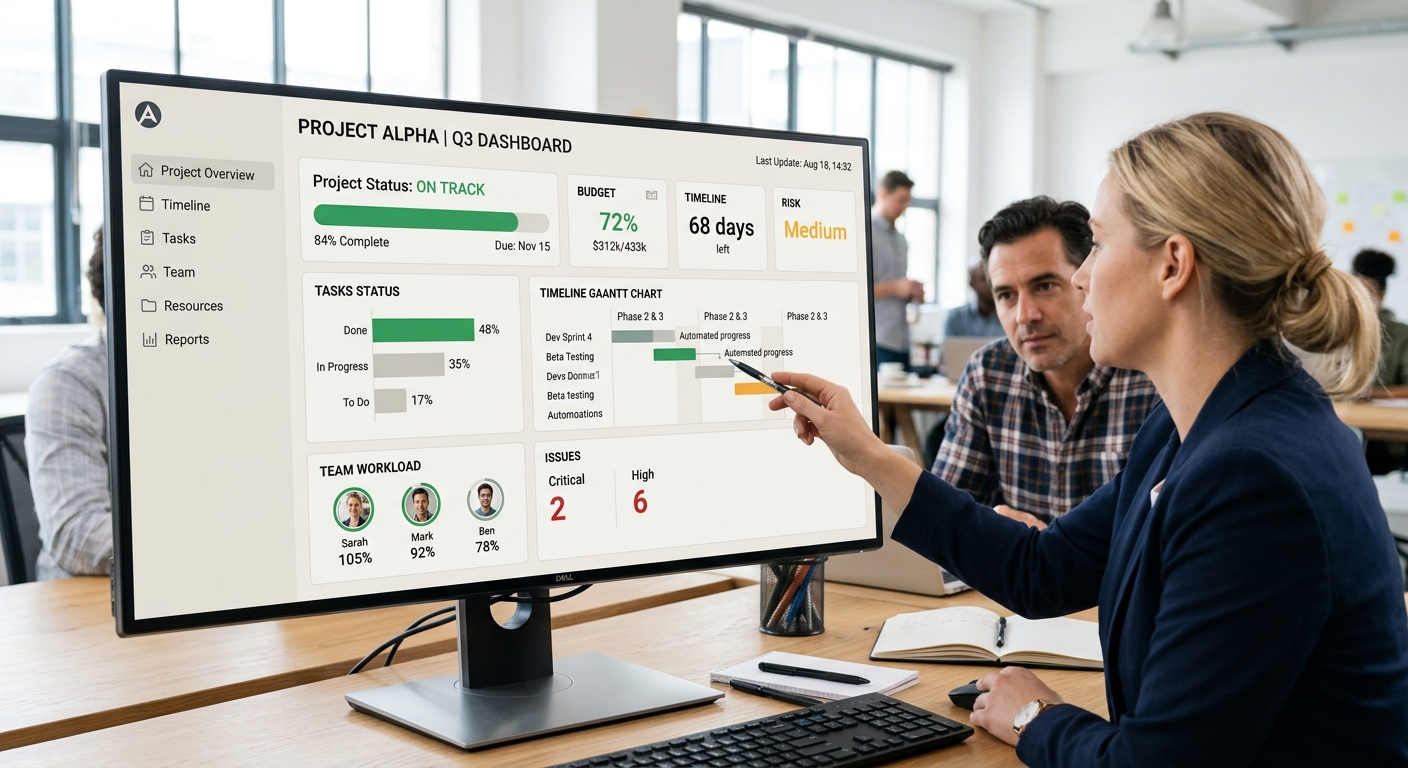
Zosma Cowork for Project Management: Automate Status Updates and Tracking
Key Takeaways
- Project managers spend 30-40% of their week on admin work like status reports and chasing updates.
- AI-assisted reporting cuts status report time from 5.1 hours per week to under 2 hours.
- Teams using AI-assisted project management deliver on time 28% more often than traditional teams.
- Local AI tools like Zosma Cowork process project data privately on your own machine.
The Status Update Problem
Project managers spend 30-40% of their workweek on administrative tasks, with status reporting as the largest single time sink according to StrategyPeeps research. At a typical salary, that represents roughly $36,000 a year of skilled talent doing data entry instead of actual project management.
The numbers get worse at scale. A project manager running five concurrent projects spends 5-10 hours per week writing status reports alone, according to Onplana's 2026 analysis. That is essentially one full workday, every single week, just documenting progress rather than driving it.
The core issue is not lazy project managers. It is that project management tools capture some data automatically, but most of the signal lives in Slack threads, email chains, and verbal conversations. The project manager becomes a human API, copying information between systems.
Where Status Report Time Actually Goes
A typical 90-minute status report breaks down like this:
- 25 minutes hunting for data across tools, messages, and notes
- 20 minutes drafting the structured content
- 22 minutes rewriting for different audiences
- 13 minutes waiting for review and revisions
- 10 minutes sending and following up
The same underlying status needs different framing depending on who reads it. Your sponsor wants one page max in bullet points. Your team needs detail with context. Your steering committee expects a 60-second executive summary. Most project managers iterate three or four times on that same update paragraph alone.
The Cost of Manual Tracking
Seven hundred and two percent of practitioners spend half a day or more every month manually collating project reports, according to Wellingtone. Only 36% of organizations mostly or always complete projects on budget, and just 49% deliver on time. The admin burden directly contributes to missed signals and slower responses.
When Sarah managed manufacturing projects for a client, her Friday afternoon status meeting took two hours. After connecting their SharePoint project lists to automated dashboards, the same meeting took thirty minutes. Her team went from 67% on-time delivery to 89% in six months, per StrategyPeeps. Not because they changed methodology. Because she had time to actually manage the project instead of copying data.
How AI Transforms Project Reporting
Teams using AI-assisted project management tools deliver on time 28% more often than teams using traditional software, based on outcome data from 2,800 projects tracked over 18 months in PMI's Pulse of the Profession 2025. The average time project managers spend on status reporting drops from 5.1 hours per week to 1.8 hours after deploying AI-powered reporting, according to a McKinsey Global Survey on PM Technology from 2025.
AI does not replace judgment. It handles the mechanical work of assembly, formatting, and distribution. The human stays in the loop for context and decisions.
What AI Actually Delivers Today
The low-effort, high-payoff capabilities are drafting and summarization. Feed your project tracker data into an AI system, get a draft status report in under a minute, edit it for tone and audience, and ship it. This replaces the 30-minute Friday afternoon report-writing session with a five-minute review, according to Ardent Workshop's 2026 assessment.
Auto-generated meeting transcripts and action items now produce output good enough to send to stakeholders with light editing. A 45-minute status meeting that once required 20 minutes of post-meeting note cleanup can now take about five minutes to review and correct.
Risk Detection and Early Warning
AI risk detection catches problems 14 days earlier than manual reviews, per PMI data. That is a meaningful window for course correction. The system identifies patterns in delays, dependency chains, and slippage that human reviewers miss when managing multiple projects simultaneously.
Predictive scheduling and budget forecasts are less mature. Gartner predicted that over 40% of agentic AI projects will be canceled by the end of 2027 due to escalating costs or unclear business value, per their June 2025 report. The autonomous agent pitch falls apart against real projects with ambiguous status and humans who do not update tickets on time.
The Zosma Cowork Approach
Most AI project tools require cloud subscriptions, seat licenses, and monthly per-user fees. Zosma Cowork takes a different approach. It runs on your own desktop, connecting to your existing tools and data without sending anything to external servers.
When you use Cowork for project management, the AI model processes data locally. Anthropic, OpenAI, Google, Meta, and Chinese AI labs cannot see your project details because the model runs on your machine. You can share almost anything with zero risk.
Automating the Weekly Status Report
Cowork connects to your project management tools, reads the week activity, and generates structured status updates. The workflow looks like this:
- Monday: AI generates the weekly plan from backlog priorities
- Tuesday through Thursday: Meeting notes capture decisions and action items automatically
- Friday: AI drafts the status report from the week activity
- The PM reviews, adds context where needed, and sends
Total time drops from 90 minutes to about 10-12 minutes, per Onplana. That is an 80% reduction. Same signal, same quality, same human judgment.
Private Project Intelligence
Cowork remembers your projects, team structure, and reporting preferences. Over time it learns which stakeholders need which format and adjusts automatically. The knowledge stays on your machine. No data export to a cloud API.
This matters for industries where project data is sensitive. Defense, healthcare, finance, and government contractors cannot send project details to third-party AI services. Cowork eliminates that constraint entirely because processing never leaves your PC.
Multiple Projects, One Command
Running five projects simultaneously? Cowork generates all five status reports in parallel from a single prompt. The mechanical copying disappears. Each report targets the right audience format. The PM reviews and approves rather than drafting from scratch each time.
Real-World Use Cases
Project managers, program managers, and PMO leaders each benefit differently from automated status tracking. Let us look at specific scenarios.
IT Project Managers
IT project managers track tasks in Jira, communicate in Slack, and report to executives via email or PowerPoint. Cowork reads across all three sources and generates executive-ready summaries. The RAG status, milestone updates, risks, and next-week priorities assemble themselves.
In practice, the biggest time saver is data gathering. Instead of spending 25 minutes hunting through Slack threads and Jira boards, Cowork already has the consolidated view. The PM just reviews and sends.
Program Managers Running Portfolios
Program managers oversee multiple projects and need a portfolio-level view. Cowork aggregates status across all projects into a single dashboard-style report. Dependencies between projects surface automatically. Resource conflicts become visible before they cause delays.
Freelancers and Solo Founders
Solo project managers and freelancers handle everything. Cowork automates client status updates, invoice triggers, and project milestone notifications. The same AI assistant handles project tracking, client communication, and administrative follow-ups without switching between five different tools.
Getting Started: Project Automation on Your Desktop
Enterprise project management platforms with AI features cost hundreds of dollars per user per month. That pricing model does not work for everyone.
Start without infrastructure. Use Cowork to validate the benefits of local AI for your project workflows before committing to enterprise deployment. You only pay for electricity. Scale up when you see the value clearly.
Cowork connects to the tools you already use and generates status reports, meeting summaries, and action item tracking automatically. Your project data never leaves your machine.
How Zosma Helps with Project Status Automation
Zosma Cowork addresses the status reporting time sink by automating the mechanical work of project updates while keeping data private on your desktop.
- Automated status reports: Generate weekly project updates from your existing tools in under 10 minutes instead of 90
- Meeting intelligence: Auto-capture decisions, action items, and follow-ups from every status meeting
- Portfolio dashboards: Aggregate status across multiple projects into a single executive summary
- Private by design: All processing runs locally. Anthropic, OpenAI, Google, and other cloud providers never see your project data
- You only pay for electricity: No per-seat subscriptions, no monthly cloud fees
Frequently Asked Questions
How does AI automate project status updates?
AI reads data from your project tools, meeting transcripts, and communication channels, then generates structured status reports automatically. You review and send instead of drafting from scratch. The process compresses 90 minutes of work into about 10 minutes, per Onplana.
Can AI replace project managers?
No. AI handles drafting, summarization, and mechanical reporting. Project managers still provide judgment on priorities, stakeholder context, and risk decisions. AI amplifies what good project managers do rather than replacing the role. The PMs getting the most value in 2026 are the ones whose underlying project artifacts are already well-maintained, per Ardent Workshop.
Is local AI for project management secure?
Yes. Local AI runs entirely on your own machine. Project data never reaches cloud providers like Anthropic, OpenAI, or Google. This eliminates the data-sharing concerns that prevent many organizations from adopting AI project tools. Cowork keeps your project intelligence private by design.
How much time can AI save on status reporting?
AI-assisted reporting reduces status report time from 5.1 hours per week to 1.8 hours on average, according to McKinsey. Some PMs see 80% reduction when the workflow is properly set up, per Onplana.
Does Cowork work with existing project tools?
Cowork connects to your existing project management tools, messaging platforms, and document systems. It reads data from wherever your team already works and generates updates without requiring you to migrate to a new platform. You start with what you have.