Private AI Search: Build a Local Knowledge Base for Your Company
Build a private AI search engine that runs entirely on local hardware. Zero data leaves your network, zero per-query costs. You only pay for electricity.

Private AI Search: Build a Local Knowledge Base for Your Company
Key Takeaways
- Employees spend 19% of their workweek searching for internal information. Private AI search can cut retrieval time by 35–40%
- On-premise Retrieval-Augmented Generation (RAG) keeps all data inside your firewall. Zero queries hit third-party servers
- Hybrid retrieval (vector + BM25) outperforms dense-only search by 30–40% on technical documents
- At scale, private AI is 5–10× cheaper than per-seat enterprise SaaS tools like ChatGPT Enterprise or Glean
- You only pay for electricity. No per-query fees, no token pricing, no vendor lock-in
Why Cloud AI Search Is a Liability
Cloud AI tools promise instant answers over your documents, but every query sends your internal data to someone else's servers. That model works for marketing teams summarizing public blogs. It does not work for legal departments reviewing contracts, engineering teams searching architecture docs, or any organization handling sensitive information.
The problem is not encryption at rest or in transit. It is about who sees your queries, who logs them, and whether they train future models on your data. Even vendors with strong privacy commitments operate under subpoena risk and regulatory obligations that make them unacceptable data processors for classified, HIPAA-covered, or commercially sensitive content.
The compliance reality
The EU AI Act (Regulation 2024/1689) imposes governance and traceability obligations on AI systems handling sensitive data. HIPAA requires covered entities to execute Business Associate Agreements with every data processor. ITAR compliance prohibits sending controlled technical data to foreign servers. None of these frameworks comfortably fit a model where queries travel through an external vendor's infrastructure twice per request.
Shadow AI risk
Gartner's 2025 Enterprise AI Adoption Survey found that 47% of large enterprises had deployed or were actively piloting AI-enhanced enterprise search tools, up from 18% in 2023. But the same research found 30% of enterprise AI knowledge management projects never reach production, with data governance concerns cited as the primary blocker.
What Is Private AI Search?
Private AI search is a Retrieval-Augmented Generation system that runs entirely within your infrastructure. When someone asks "What are our API authentication requirements?", the query is processed locally, relevant documents are retrieved from your own vector database, and an on-premise language model generates the answer. At no point does a single byte leave your network.
How RAG works locally
The architecture has five layers:
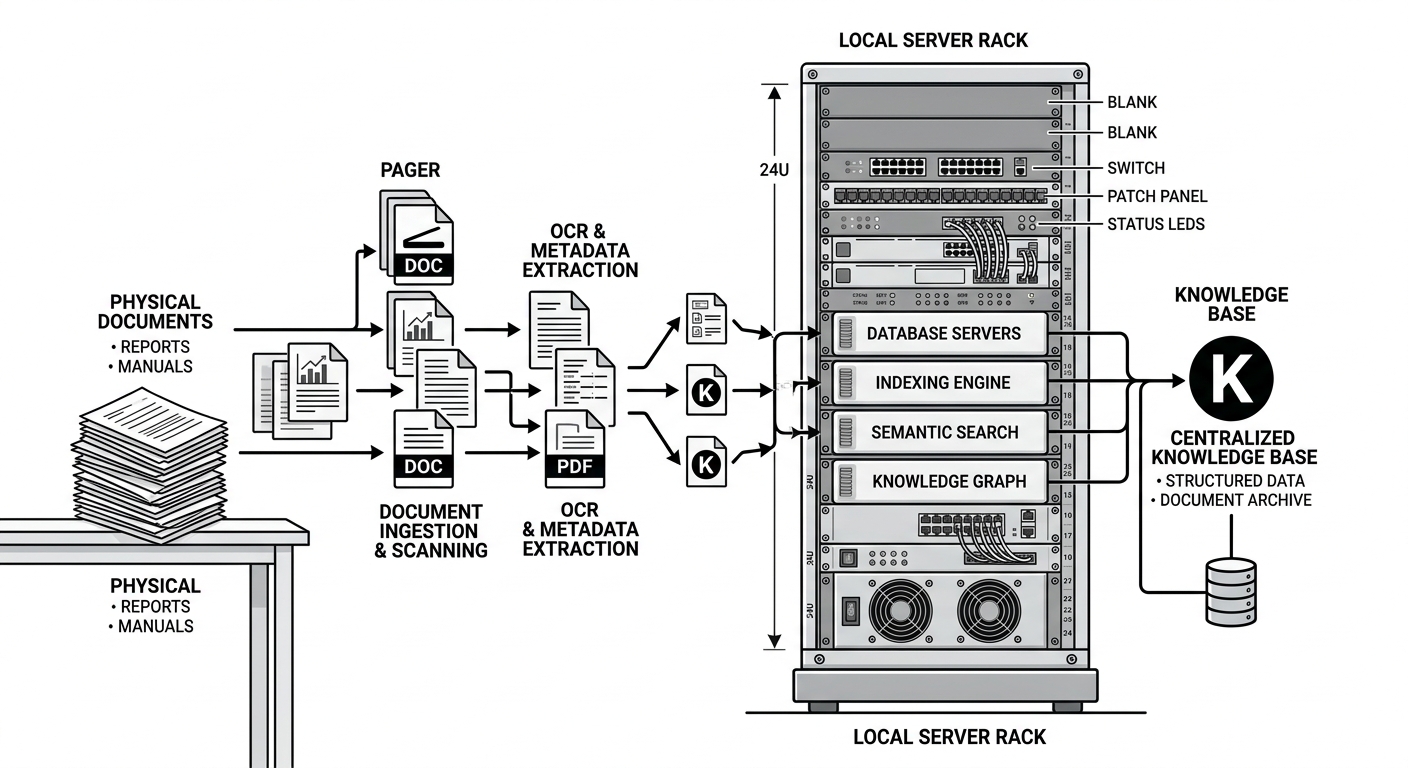
Document ingestion. Internal documents — PDFs, Word files, code repositories, Slack exports — are parsed, chunked, and converted into vector embeddings using a local embedding model.
Vector storage. Embeddings live in an on-premise vector database like Qdrant, Chroma, or LanceDB. Metadata tagging supports department-level access control.
Hybrid retrieval. When a query arrives, the system runs both semantic vector search and keyword-based BM25 search, then fuses the results using Reciprocal Rank Fusion. Hybrid retrieval delivers 30–40% better recall on technical documents compared to dense-only search.
Cross-encoder reranking. A local reranking model like BGE reranks the fused results, lifting retrieval precision substantially.
Local inference. An open-weight model running on your hardware generates the final answer from the retrieved context. No external API call.
Why retrieval quality matters more than model size
A small local model with great retrieval beats a large cloud model with bad retrieval on almost every document-Q&A task. The bottleneck in RAG systems is not generation — it is getting the right chunks into context. Production stacks typically retrieve 10–20 chunks, rerank to 5–8, and feed those to the model for answer generation.
Building a Local RAG Stack: Step by Step
Building a private AI search engine does not require a team of data scientists. The core stack can run on a single machine with moderate hardware, and the software components are mature, open-source, and well-documented.
Choosing your components
| Component | Options | Best For |
|---|---|---|
| Vector Database | Qdrant, Chroma, LanceDB | Qdrant for production, Chroma for prototyping |
| Embedding Model | nomic-embed-text, BAAI/bge-m3 | bge-m3 for multilingual, nomic for English |
| Reranker | BGE reranker-large, MiniLM | MiniLM for speed, BGE-large for accuracy |
| LLM Runtime | Ollama, vLLM | Ollama for simplicity, vLLM for throughput |
| Orchestrator | LangChain, LlamaIndex, custom | Custom for maximum control |
Chunking strategy
The single biggest determinant of RAG quality is how you split documents into chunks. Target 200–500 tokens per chunk with 50–100 token overlap between adjacent chunks. Below 200, individual chunks lose context. Above 500, embeddings become diluted across multiple topics. Semantic-aware chunkers from LlamaIndex or LangChain improve on naive fixed-size splitting, but a well-tuned basic chunker handles most use cases.
Document ingestion pitfalls
PDFs are not a single format — they are a graveyard of formats. Native digital PDFs extract cleanly with PyMuPDF or pdfplumber. Scanned PDFs need OCR. Mixed PDFs (digital cover page over scanned body) need both. Always inspect a sample after ingestion before declaring the pipeline working.
Tables need structural extraction, not flat text. Tools like Camelot or pdfplumber's table extractor produce row-by-row structure that preserves meaning during retrieval.
Production accuracy expectations
A well-tuned local RAG stack on a 1,000-document corpus delivers approximately 70–80% top-1 retrieval relevance, 90–95% top-5 recall, and 85–92% generation factuality conditioned on retrieved context. These numbers come from operator reports across 2025–2026 and represent the practical ceiling of current technology.
Cost Comparison: Private vs. Cloud AI Search
Cloud AI pricing follows a per-token or per-query model. At small scale, hosted SaaS is cheaper. Past approximately 100 seats, private AI economics flip dramatically.
The math
A 100-person company on Glean pays approximately $72,000/year just in software licensing. ChatGPT Enterprise at 500 seats runs $360,000–$600,000/year. A standard private AI deployment plus one year of managed service costs roughly the same as the first year of Glean — but you own the stack from year two onward.
Forrester's Total Economic Impact studies found three-year ROI figures for AI knowledge management platforms ranging from 195% to 340%, with payback periods of 8–14 months. IDC research found organizations with mature AI knowledge management deployments reported $8.10 in return per dollar invested over three years — higher than the broader enterprise AI average of $3.50.
You only pay for electricity
Private AI eliminates the token-based pricing model entirely. Once the hardware is deployed, ongoing costs are power and maintenance. There are no per-query fees, no rate limit charges, no surprise bills from an unexpected search spike. This is the fundamental economic advantage of local AI — you only pay for electricity.
When Private AI Makes Sense (and When It Does Not)
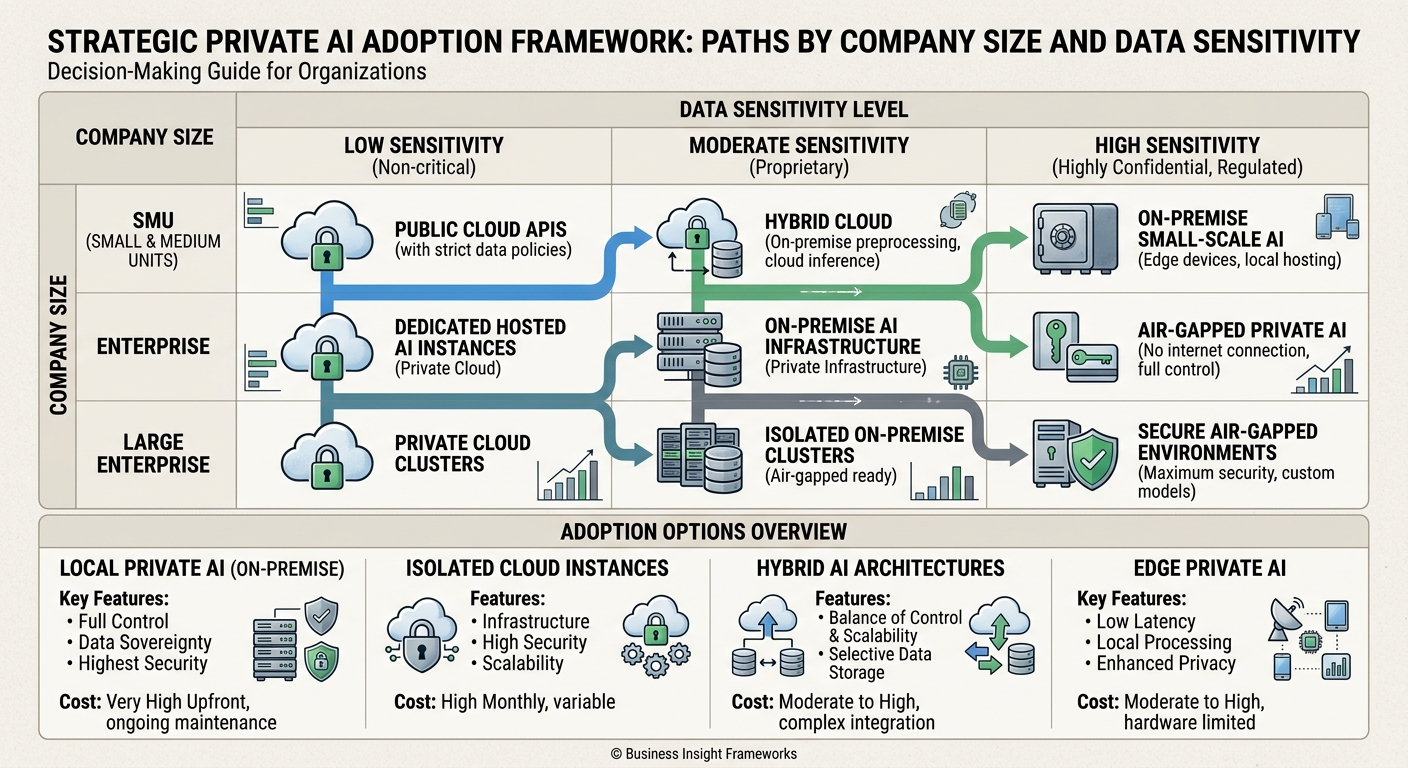
Not every organization needs a local AI knowledge base. Understanding your data sensitivity profile and usage scale determines whether private AI is the right fit.
Ideal candidates for private AI
Regulated industries. Healthcare organizations under HIPAA, financial services under data residency rules, government contractors with ITAR requirements. Private AI is not optional — it is a compliance requirement.
Large organizations. Past 100–200 seats, per-seat SaaS pricing becomes punitive. Private AI scales without licensing overhead.
Highly sensitive data. Proprietary product roadmaps, M&A documents, customer databases. The data sensitivity, not the organization size, often drives the decision.
When cloud AI is still reasonable
Small teams. Under 20–30 users with low-sensitivity data, hosted tools like Notion AI or standard ChatGPT Enterprise may be cheaper and simpler.
Early experimentation. Teams still evaluating whether AI search solves their actual problems should start with cloud tools to validate the use case before investing in local infrastructure.
Simple knowledge bases. If your content is all public-facing documentation, cloud AI introduces minimal risk and faster time-to-value.
Implementation Checklist
Deploying a private AI search system requires coordination between IT, security, and the business units that will use it. Here is what to validate before going live.
Infrastructure prerequisites
Hardware assessment. Determine GPU availability for local model inference. Ollama handles CPU inference, but GPU acceleration through vLLM dramatically reduces latency. For a 14B–32B parameter model, expect 4–16 GB of GPU memory depending on quantization level.
Network architecture. Separate Docker networks for frontend and backend tiers reduce the attack surface. The inference engine and vector database should never be directly accessible from the browser layer.
Storage sizing. A 10,000-document corpus with vector embeddings requires approximately 10–50 GB of storage depending on document size and embedding dimensionality.
Security controls
Department-level data segregation. Engineer access control at the retrieval layer, not the prompt. Role-filtered indexes, classification metadata on every document, and query-time authentication tied to verified user identity. A Finance query must never return HR documents.
Audit trail. Log every query, retrieved chunk, and generated response. The EU AI Act requires documentary traceability for AI systems processing sensitive data.
Model and index updates. Establish a governance process for model updates, index refreshes, and periodic red-team testing to confirm no department can extract information it is not authorized to access.
How Zosma Helps
Building and maintaining a private AI search stack requires expertise in RAG architectures, vector databases, and local model deployment. Zosma Cowork simplifies local AI workflows by providing document processing and private data handling capabilities that run entirely on your infrastructure.
You can start small and scale up — the private AI advantage is that you only pay for electricity, with no per-seat licensing that grows as your team expands.
Frequently Asked Questions
Can I build a private AI search system without GPUs?
Yes. Ollama supports CPU inference for models up to 32B parameters. CPU inference is slower than GPU, but perfectly functional for document search workloads where queries arrive at moderate throughput. For production-scale deployment, GPU acceleration through vLLM reduces latency significantly.
What happens when documents are updated or deleted?
A well-designed RAG system maintains a document index that tracks source files by hash. When a document changes, the system detects the change through content hashing, removes old chunks, and re-indexes the updated version. Automated sync connectors for SharePoint, Google Drive, or Git repositories keep the index current without manual intervention.
How accurate is local AI search compared to cloud tools?
A well-tuned local RAG stack achieves 70–80% top-1 retrieval relevance and 85–92% generation factuality. Accuracy depends primarily on chunking quality, retrieval strategy, and document ingestion — not on model size. A local model with excellent retrieval outperforms a cloud model with poor retrieval on almost every document-Q&A task.
Is private AI worth it for small businesses?
Under 30 seats with low-sensitivity data, cloud AI tools are simpler and cheaper. The economics tip around 100 seats. Small businesses with highly sensitive data — such as healthcare providers handling patient records or legal firms managing case files — should consider private AI regardless of size.
Can private AI integrate with existing workplace tools?
Yes. Production RAG systems connect to Slack, Google Drive, Confluence, Jira, Salesforce, and Microsoft 365 through API connectors. Permission-aware retrieval ensures employees only see content they have access to in the source application. The integration layer sits entirely within your infrastructure.
Build your company's private AI knowledge base. Start by auditing what documents your teams search for most, how long it takes them to find answers, and whether those documents leave your network when someone uses a cloud AI tool. The answer to that last question usually determines whether private AI is a nice-to-have or a requirement.