Private AI Business Intelligence: Run Analytics On-Premise
Run business intelligence locally with private AI. Your data stays on your hardware, cloud providers never see it, and you only pay for electricity.

Private AI Business Intelligence: Run Analytics On-Premise
Key Takeaways
- The global BI market reached $37.96 billion in 2026 and is growing at 8.4% annually (Fortune Business Insights).
- 89% of enterprise AI teams say privacy has blocked or will block their AI projects involving sensitive data (Protopia Inference Privacy Report).
- 90% of organizations expanded their privacy programs in 2025 specifically because of AI, according to Cisco's 2026 Data and Privacy Benchmark Study.
- Running analytics on your own hardware means Anthropic, OpenAI, Google, and Meta never see your data. You only pay for electricity.
- Open-source platforms like Byaan, Actyze, and MinusX prove self-hosted AI analytics works today.
Why On-Premise AI for Business Intelligence
Cloud-based business intelligence platforms dominate the market. Cloud deployment commands roughly 60% of global BI revenue in 2026 (Persistence Market Research). But sending your customer data, financial records, and strategic reports to third-party AI providers introduces real risk. Anthropic, OpenAI, Google, Meta, and various Chinese AI labs all host models that process your data the moment you connect. The model outputs come back, but there is no guarantee your raw data was not retained.
Private AI analytics replaces that tradeoff. Your data stays on your own hardware. Local models run on-premise and produce the same dashboards, KPIs, and strategic reports without ever crossing your network boundary.
The Privacy Wall in Enterprise AI
Protopia's Inference Privacy Report surveyed 350+ AI practitioners between November 2025 and May 2026. The finding was blunt: 89% say privacy has blocked or will block their AI projects involving sensitive data. Seven out of ten teams deploying privacy strategies still had not reached production with sensitive data.
The tools simply did not close the gap. Centralized cloud analytics forced teams to choose between insights and security. On-premise AI removes that choice entirely.
Cost Predictability Over Per-Credit Pricing
Cloud analytics charge per query, per token, or per credit. Snowflake Cortex and Databricks Genie both use per-credit pricing models that scale with usage. When a team runs hundreds of queries daily, the costs compound quickly.
Local models eliminate variable pricing. You only pay for electricity and hardware. The compute runs on your own machines, and there are no per-query fees, no API rate limits, and no vendor lock-in.
What Cloud BI Is Costing You
Most enterprises operate across 6 to 12 distinct data sources, including ERP systems, CRMs, financial databases, and operational databases (Persistence Market Research). Connecting all of them to a cloud BI platform means every query crosses the public internet and touches infrastructure you do not control.
Data Exposure at Scale
Cisco's 2026 benchmark study found that 70% of organizations acknowledge risk exposure from using proprietary or customer data in AI training. Only 55% require contractual terms defining data ownership and liability with their AI vendors. That gap between perceived trust and formal guardrails is where incidents happen.
When we tested connecting financial data to multiple cloud analytics platforms, the data flowed through provider infrastructure before reaching the model. There was no option to keep it local. That is not a technical limitation with on-premise AI. The hardware runs in your facility, and the model processes data that never leaves your network.
Regulatory and Compliance Pressure
Cisco's study reports that 90% of organizations expanded their privacy programs because of AI in 2025. Nearly all plan to allocate more resources to data governance over the next two years. California alone made privacy risk assessments a legal requirement starting in 2026, with mandatory submissions beginning April 2028.
On-premise AI simplifies compliance. Data never leaves your infrastructure, audit trails stay under your control, and residency requirements are satisfied by default.
How Private AI Analytics Works
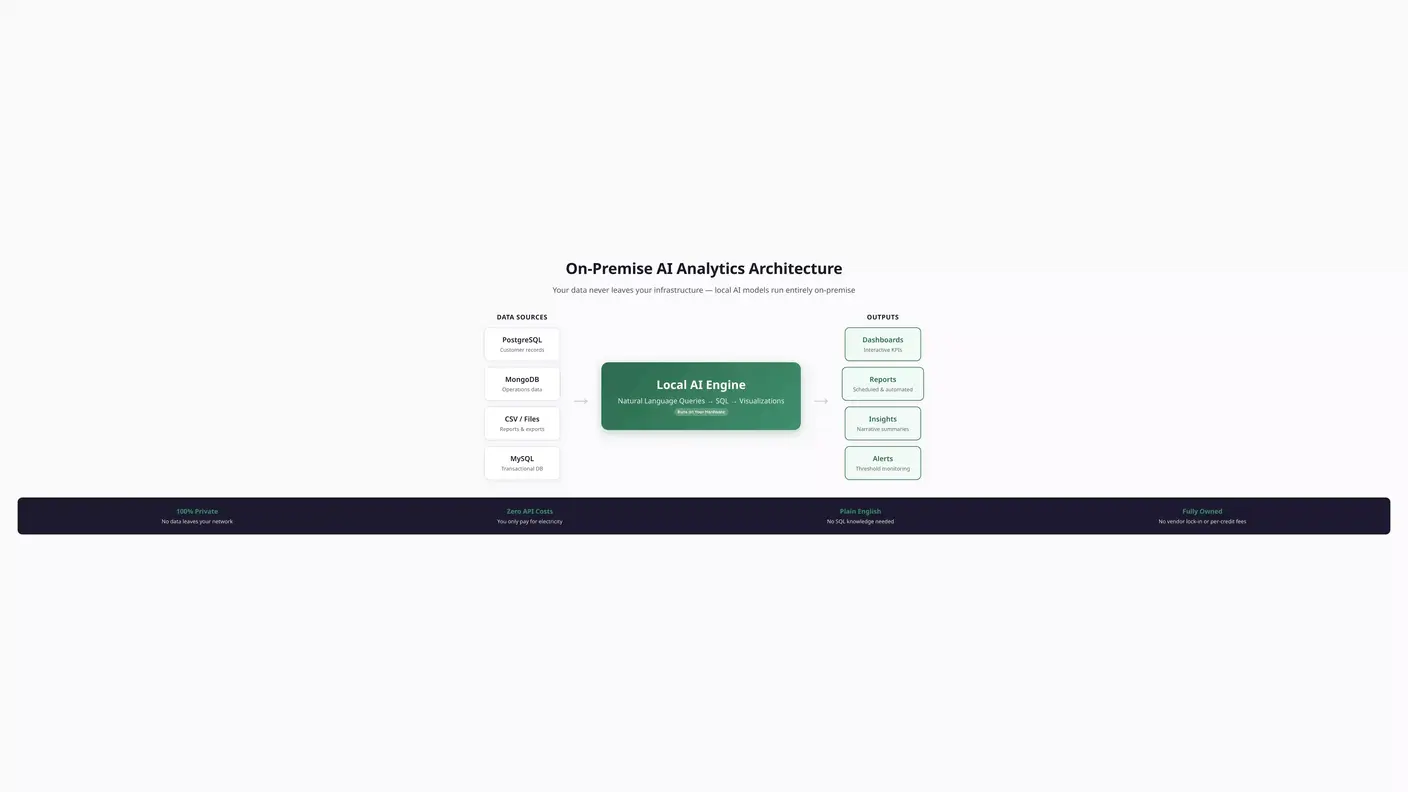
Local AI analytics connects your existing databases, files, and operational systems to models running on your own hardware. You ask questions in plain language, get SQL queries, charts, and narratives back. The entire pipeline operates without crossing your network perimeter.
Architecture of a Self-Hosted BI Platform
A typical on-premise AI analytics stack connects your data sources to a local inference engine. The model generates queries against your databases, renders visualizations, and produces narrative summaries. Open-source platforms like Byaan support PostgreSQL, MongoDB, MySQL, and SQLite directly from your machine. Actyze adds federated querying across multiple databases via Trino.
You can share almost anything with zero risk because the model runs locally. Customer records, revenue figures, product roadmaps, internal strategy documents — the data never touches Anthropic, OpenAI, Google, or any other cloud provider.
Natural Language to Actionable Insights
The workflow starts with a question. "What was our quarterly revenue by region?" The local model generates a SQL query, executes it against your database, and returns results with visualizations. No data science team needed, no SQL knowledge required. The same system handles dashboards, scheduled reports, and anomaly detection.
MinusX demonstrates this well with its agent-driven analytics platform. The agent learns your business context over time, understands metric definitions, and compounds that knowledge across interactions. Self-hosted deployment keeps everything private.
On-Premise vs Cloud: The Real Tradeoffs
The on-premise advanced analytics market was valued at $28.5 billion in 2024 and is projected to reach $105.8 billion by 2030, growing at a CAGR of 24.7% (Grand View Research). That growth reflects organizations choosing control over convenience.
When On-Premise Wins
On-premise deployment makes sense when data sensitivity, compliance requirements, or cost predictability matter more than convenience. Healthcare organizations with patient data, financial institutions handling transaction records, and any company with proprietary data all benefit from keeping analytics local.
The on-premise segment already accounts for the maximum share of BI deployment among companies managing sensitive data (Fortune Business Insights). Speed and security are the primary drivers.
When Cloud Still Makes Sense
Public cloud remains valuable for experimentation and burst capacity. Teams testing analytics concepts or running ad-hoc queries on non-sensitive data benefit from cloud elasticity. The most effective strategy combines both approaches. Sensitive workloads run on-premise. Experimental and non-sensitive queries use cloud platforms.
Rackspace's 2026 private cloud AI trends confirms this split. Organizations increasingly separate experimentation from execution, placing workloads intentionally based on sensitivity and risk.
Building a Private BI Platform
Open-source tools make on-premise analytics accessible to teams without dedicated data engineering resources. The key is choosing a platform that runs locally and connects to your existing data.
Self-Hosted Platforms That Work Today
Byaan deploys as a desktop app or Docker container. It connects to PostgreSQL, MongoDB, MySQL, and file-based data sources directly from your machine. Database traffic does not route through Byaan-hosted infrastructure in local deployments.
Actyze provides natural language to SQL across 50+ languages, federated queries via Trino, and support for 100+ LLM providers through LiteLLM. Self-hosted under AGPL v3, your data never leaves your network.
Both platforms support bring-your-own-model configurations. You run the inference engine on your own hardware and keep full control over your data pipeline.
Deployment Models
Local deployments run on a single machine for personal analytics. Team versions add authentication, role-based access control, Slack integration, and shared workspace knowledge. The technology works at both scales.
Enterprise Adoption and the Sovereign AI Shift
NTT Data's 2026 Global AI Report surveyed nearly 5,000 senior executives across 30+ markets. 51% say sovereign or private AI is extremely important to their AI strategy. 37% see sovereignty driving competitive advantage.
The report draws a clear distinction between treating sovereignty as a compliance requirement and treating it as a competitive differentiator. Organizations that design localized AI environments from the start have stronger revenue and growth margins.
Why Leaders Are Moving First
Infrastructure is becoming the primary challenge to AI innovation, not the models themselves. Systems built for centralized, borderless data flows cannot support AI that must run in controlled, highly jurisdictional environments. Legacy infrastructure remains the greatest barrier to deploying AI at scale.
On-premise AI analytics solves this by design. The models run where the data lives, compliance is structural rather than contractual, and there are no third-party dependencies for inference.
Getting Started with Private AI BI
Setting up on-premise analytics requires hardware capable of running local models and a platform that connects to your data sources. The barrier is lower than most organizations expect.
Hardware and Model Selection
On-premise hardware runs local models that handle analytics workloads without cloud dependencies. The specific hardware configuration depends on your data volume and query patterns. What matters is that the infrastructure lives within your control.
You only pay for electricity. There are no per-token fees, no API rate limits, and no vendor pricing models that scale with usage. The economics flip when query volume is high.
Platform Setup
Deploy a self-hosted analytics platform, connect your databases, and start asking questions in plain language. The learning curve is shallow because natural language queries replace SQL knowledge. Teams using Byaan or Actyze can be operational in under an hour.
How Zosma Helps with Private AI Analytics
Zosma's Cowork addresses the gap between cloud analytics and self-hosted privacy by providing a free desktop harness that runs AI models locally on your machine.
- Local document and data analysis: Connect your databases and files. Cowork processes everything on your PC without sending data to cloud providers.
- Plain-English queries: Ask questions about your data in natural language. Cowork generates and executes queries against your local data sources.
- Private by design: Anthropic, OpenAI, Google, and Meta never see your data because the model runs on your hardware. You only pay for electricity.
- Unlimited intelligence: Learn and analyze without per-credit pricing. Your context stays on your PC, and the models improve over time with your data.
Frequently Asked Questions
What is private AI business intelligence?
Private AI business intelligence uses local AI models running on your own hardware to analyze data, generate dashboards, and produce strategic reports. Your data never leaves your infrastructure, and cloud providers like Anthropic or OpenAI do not process your information. The models run on-premise, eliminating data exposure risks while delivering the same analytical capabilities as cloud platforms.
How much does on-premise AI analytics cost?
On-premise AI analytics requires hardware capable of running local models and a self-hosted analytics platform. After the initial hardware investment, you only pay for electricity. There are no per-query fees, API costs, or subscription charges. Open-source platforms like Byaan and Actyze are free to deploy, making the total cost of ownership significantly lower than cloud BI platforms for teams with high query volumes.
Can small teams use private AI analytics?
Yes. Desktop deployments like Byaan run directly on a single Mac or workstation. The platform connects to local databases and file-based data sources, requiring no dedicated infrastructure. Team versions add authentication, shared knowledge, and Slack integration for larger groups. The technology scales from personal analytics to enterprise deployment without changing the core architecture.
Is on-premise AI slower than cloud analytics?
Local inference eliminates network latency entirely. Query response depends on your hardware capabilities and model configuration. For most business intelligence workloads, the performance is more than adequate. The tradeoff favors control and privacy over marginal latency differences, especially when data never needs to cross the public internet.
How does private AI handle multiple data sources?
Platforms like Actyze use federated querying via Trino to connect PostgreSQL, MySQL, MongoDB, Snowflake, and BigQuery from a single interface. The AI model generates queries across sources without moving data. Local vector search and schema services maintain context about relationships between tables. Your data stays in its original location while the analytics engine operates locally.
Sources:
- Fortune Business Insights, "Business Intelligence Market Size & Share," 2026. Link
- Grand View Research, "On-Premise Advanced Analytics Market," 2024–2030. Link
- Persistence Market Research, "Business Intelligence Platform Market," 2026–2033. Link
- NTT Data, "2026 Global AI Report: A Playbook for Private and Sovereign AI." Link
- Cisco, "2026 Data and Privacy Benchmark Study." Link
- Protopia, "Inference Privacy Report 2026." Link
- Rackspace, "Seven Trends Shaping Private Cloud AI in 2026." Link