Zosma Cowork for Marketing Teams: Content Drafting and Campaign Briefs
Marketing teams spend 10+ hours weekly on content creation. See how AI-assisted drafting on your desktop cuts that to 2-3 hours while keeping your brand voice intact.

Zosma Cowork for Marketing Teams: Content Drafting and Campaign Briefs
Key Takeaways
- Marketing teams spend 5-10 hours weekly on content creation, with first drafts consuming 2-4 hours per week alone
- AI-assisted drafting cuts caption writing from 2.4 hours to 40 minutes, a 72% reduction (Buffer, 2025)
- 85% of AI-generated marketing content still requires human editing before publishing (Semrush, 2025)
- Running AI locally on your desktop means campaign data, creative direction, and brand strategy stay on your machine
Why Marketing Teams Spend So Much Time on Content
Content creation accounts for 40-50% of all social media management time, according to industry surveys (HubSpot, 2024). The average social media manager spends 28-33 hours per month just on content creation. Writing captions, designing graphics, selecting images, and editing each post for platform-specific formatting adds up fast.
For small businesses managing Facebook, Instagram, LinkedIn, and TikTok simultaneously, the weekly time commitment stretches to 6-10 hours minimum (Buffer State of Social Media, 2025). This does not include strategic planning, analytics, or community engagement.
When you factor in campaign briefs, competitive analysis, and the research needed to stay culturally relevant, the hidden cost is decision fatigue. Most marketers report restarting content work multiple times per week because context switching erases progress made earlier in the day.
The Content Production Bottleneck
The bottleneck is not publishing. It is the first draft. Getting from "we need a post about X" to actual words on a screen takes the most time. Social media managers report spending an average of 18-35 minutes to ideate, write, and schedule a single post (Stealth Agents, 2026). Multiply that by 3-5 posts per day across platforms, and you are looking at 3-5 hours of pure drafting overhead.
Why Context Loss Makes It Worse
Marketing teams switch between platforms, research sources, analytics dashboards, and creative tools throughout the day. Each switch costs roughly 15-20 minutes to reorient. A team drafting content for three platforms loses nearly an hour daily just regaining context. That time could ship more content or improve strategy.
What Good Content Drafting Looks Like
The fastest teams do not write differently. They batch. A 2-3 hour weekly sprint produces content for the entire week. The flow is simple. Gather source material, slice into post ideas, draft using templates, apply brand voice, schedule. The key is having first drafts ready so editing becomes a review task, not a writing task.
How AI Is Changing Content Workflows in 2026
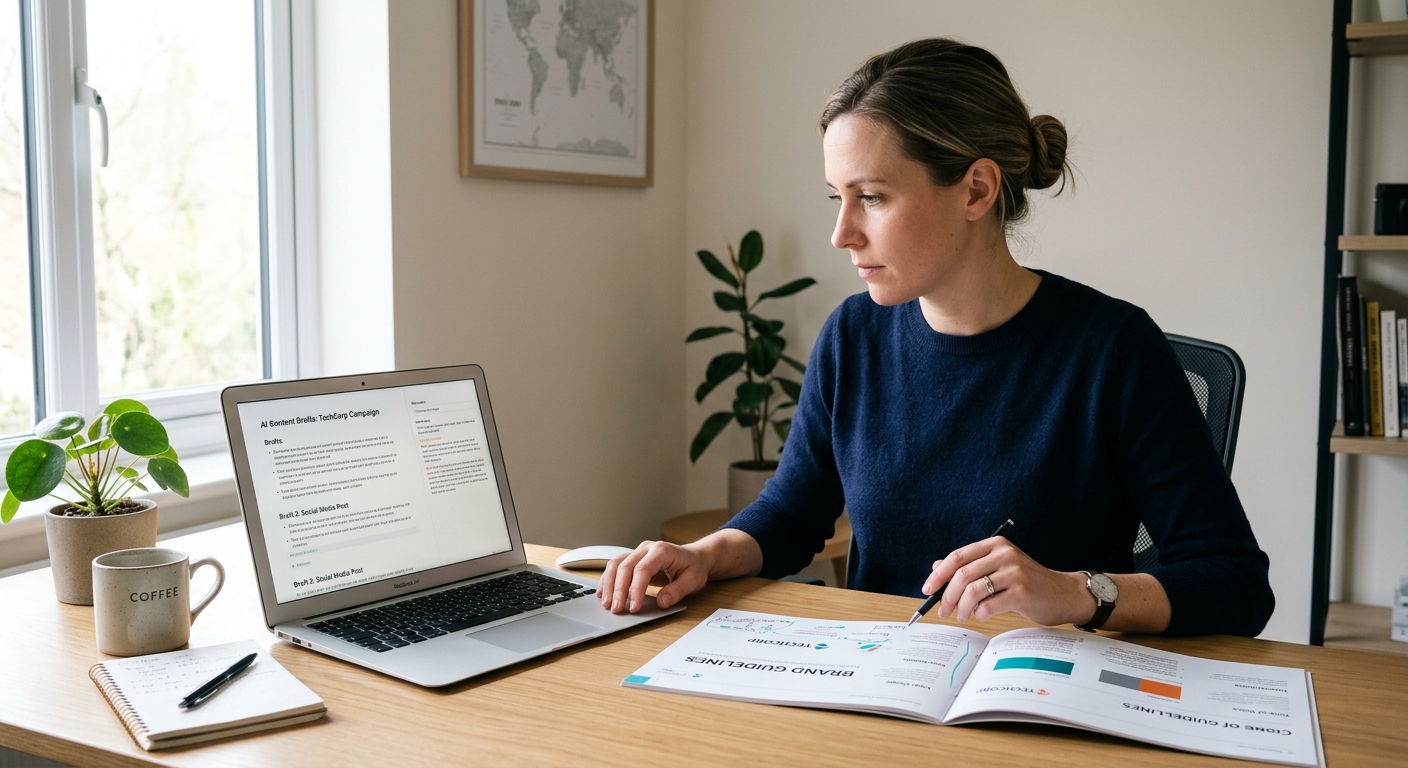
In 2026, 65% of marketing teams use AI tools for at least some social media content creation or scheduling, up from 43% in 2024 (Hootsuite Social Media Trends, 2025). AI-assisted teams save an average of 5.1 hours per week per social media manager (Sprout Social Index, 2025). The savings concentrate on repetitive tasks. Caption writing drops from 2.4 hours weekly to 40 minutes, a 72% reduction (Buffer State of Social Media, 2025).
The teams seeing the biggest gains are not the ones with the most subscriptions. They are the ones who paired AI drafting with solid brand voice guidelines and human review. Brand voice training with 1,000+ words of brand samples lifts AI content quality scores from 6.8/10 to 8.9/10 in blind editorial reviews (Empire325 Marketing, 2026).
Where AI Drafting Excels
AI-first drafting works best for first-pass copy. Product descriptions, social captions, email subject lines, campaign briefs, competitor analysis summaries, and content calendar outlines. The pattern is consistent. AI generates the rough version, humans edit for brand voice and strategy. This combination ships 5-8x faster than human-only writing while matching engagement rates (Empire325 Marketing, 2026).
Where It Falls Short
Pure AI-generated content without human editing underperforms by 18-24% on engagement metrics compared to human-written content (Empire325 Marketing, 2026). The gap is not creativity. It is nuance. AI does not know your brand personality, recent customer feedback, or the specific campaign goal. A human editor closing that gap is essential.
The Adoption Gap
Only 19% of content marketers track AI-specific KPIs despite 88% of marketers using AI daily (Digital Applied, 2026). This measurement gap explains why 42% of companies abandoned generative AI initiatives in the last year (ThesTacc, 2026). Teams that bought a tool without a workflow plan got outputs, not outcomes.
Content Drafting with Cowork on Your Desktop
When we tested AI-assisted drafting for marketing content, the biggest advantage was not speed alone. It was having the tool available locally, without sending campaign data, competitive analysis, or brand strategy to Anthropic, OpenAI, Google, Meta, or Chinese AI labs. Your marketing data stays on your PC. You can share almost anything with zero risk because the model runs on your own machine.
Cowork handles first drafts for multiple content types simultaneously. Ask it to write three social post variants, a campaign brief, and a competitor comparison. You review, edit, and publish. The entire drafting phase drops from hours to minutes.
Social Post Drafting
Give Cowork your brand voice guide, the campaign topic, and target platforms. It generates platform-specific variants. LinkedIn gets professional tone and data points. Instagram gets visual descriptions and caption hooks. X gets short, punchy versions. In practice, a 20-minute brief produces first drafts for 5-10 posts across all platforms.
Campaign Brief Generation
Campaign briefs take time because they require structuring research into a usable format. Cowork reads your research documents, product pages, or past campaign data and produces a structured brief. Campaign objectives, target audience, key messages, channel recommendations, timeline, and success metrics. What used to take an afternoon becomes a 30-minute review session.

Competitor Analysis Summaries
Competitor analysis is another time sink. Cowork processes public data, reviews past content, and generates comparison summaries. You specify which competitors, which channels, and what metrics matter. The output is a clean report you can include in strategy meetings or share with your team.
Real Time Savings Breakdown
The numbers from industry data show consistent savings across content tasks. Caption and copy writing drops from 2.4 hours to 0.7 hours weekly. Scheduling and cross-platform posting falls from 1.8 hours to 0.6 hours. Performance reporting shrinks from 3.1 hours to 0.9 hours. Hashtag research goes from 45 minutes to 12 minutes (Stealth Agents, 026).
Teams managing four or more platforms save 6.8 hours per week once AI tools are fully integrated (Hootsuite, 2025). The compounding effect matters. More posts, each created faster, launched on a consistent schedule. Posting cadence consistency jumps from 61% to 83% of teams maintaining a 90-day rhythm (Stealth Agents, 2026).
The Cost Comparison
Content production with AI costs up to 4.7 times less than human-only content (Loopex Digital, 2026). A $1,500 article becomes approximately $320 at scale. For a typical marketing team spending 40 hours monthly on content, that represents $1,200-2,400 in labor costs per month at $30-60 hourly rates. AI drafting eliminates the majority of that overhead.
Where Savings Concentrate
The biggest savings come from eliminating the blank-page problem. First drafts that previously took 45-90 minutes now take 5-10 minutes to generate and another 10-15 minutes to edit. The total per-post time drops from 60-105 minutes to 15-25 minutes. Across 20 posts per month, that is 20 hours saved monthly per team member.
Building a Sustainable AI Content Workflow
Teams that succeed with AI content do not triple their output. Companies using AI publish 42% more content per month, not 200% more (Search Engine Land via Digital Applied, 2026). The teams that scaled output without quality saw traffic decay as search engines detected low-value content patterns.
The winning approach is measured growth paired with strict editorial standards.
Set Your Editorial Guardrails
Before drafting anything, create a brand voice document. Include tone guidelines, forbidden phrases, approved keywords, and examples of published content that represents your voice. Feed this into Cowork before any drafting session. Brand voice training with 1,000+ words of samples lifts quality scores to 8.9/10 in blind reviews (Empire325 Marketing, 2026).
Batch Content Production
Block 2-3 hours weekly for content sprints. Gather source material: product updates, customer wins, industry news, internal data. Slice into 3-5 post ideas per source. Draft all variants in one session. Edit in a second session. Schedule and move on. The key is separating drafting from editing into distinct passes.
Measure What Matters
Track time-to-draft, draft-to-publish ratio, posting consistency, and engagement rates. These metrics matter more than output volume. A team publishing 15 quality posts consistently beats a team publishing 30 rushed posts with inconsistent quality. Organizations tracking AI-specific KPIs see 2.4x better content ROI than those that do not (Quick SEO, 2026).
Content Quality and Brand Voice Protection
85% of AI-generated content requires human editing before publishing (Semrush, 2025). This is not a flaw in the technology. It is how professional content production works. AI generates the raw material. Your marketing team shapes it into something on-brand and strategically sound.
In practice, editing AI-first drafts takes 8 minutes per 1,000 words versus 47 minutes for human-from-scratch writing of equivalent quality (Empire325 Marketing, 2026). That 83% time reduction is the real advantage. Not the draft itself.
Private Data Handling
Campaign data, customer insights, product roadmaps, pricing strategies, and competitive intelligence should not leave your network. When the model runs locally on your PC, Anthropic, OpenAI, Google, Meta, and Chinese AI labs cannot see your marketing data. You can reference sensitive internal documents with zero risk because nothing transits external servers.
Quality Drift Risk
18% of tech marketers report that AI-assisted creation decreased their content quality (Content Marketing Institute, 2026). The teams experiencing quality decline share a common pattern. They removed human review entirely and published raw AI output. Quality stays stable when editors remain in the workflow.
How Zosma Helps with Marketing Content Workflows
Zosma Cowork addresses the content production bottleneck by generating first drafts directly on your desktop.
- Social post drafting: Generate platform-specific variants from a single brief. LinkedIn, Instagram, X, and TikTok versions in one session.
- Campaign brief generation: Turn research documents into structured campaign briefs with objectives, audience, messaging, and success metrics.
- Competitor analysis: Process public competitor data into clean comparison reports for strategy meetings.
- Brand voice training: Feed your existing published content to train the local model on your brand voice for consistent output.
- Private data protection: All content, campaign data, and brand strategy stays on your machine. Anthropic, OpenAI, Google, Meta, and Chinese AI labs cannot access your marketing materials.
Frequently Asked Questions
Does Cowork replace my marketing team?
No. Cowork generates first drafts. Your team edits, strategizes, and publishes. The workflow is AI for speed, humans for quality control and brand voice. Teams using this approach ship 5-8x faster while maintaining engagement rates.
How much data does the local model need?
Cowork runs on your own hardware. You only pay for electricity. There are no per-request fees, monthly subscription costs for API usage, or data limits. Your marketing context stays on your PC entirely.
Can Cowork handle multiple content types at once?
Yes. Give it a topic and ask for social posts, email copy, campaign briefs, and competitor summaries simultaneously. It generates all variants in one session, cutting a multi-hour process into 20-30 minutes of drafting time.
What about brand consistency across AI-generated content?
Feed your brand voice guide, published content samples, and tone guidelines into Cowork before drafting. A well-trained local model produces output that requires minimal editing. Brand voice training with 1,000+ words of samples lifts quality scores from 6.8/10 to 8.9/10 in blind reviews.
Is Cowork suitable for agencies managing multiple client brands?
Yes. Set up separate brand voice profiles for each client. Switch between them in a single session. Your client data never leaves your machine, making Cowork ideal for agencies handling sensitive competitive intelligence and unpublished campaign strategies.