Zosma Cowork for HR: Automate Onboarding Checklists and Employee Communications
How HR teams use AI to automate onboarding checklists, policy drafting, and internal communications without expensive enterprise software.

Zosma Cowork for HR: Automate Onboarding Checklists and Employee Communications
Key Takeaways
- Only 12% of employees rate their employer's onboarding as adequate (Gallup), yet structured programs improve retention by 82% (Brandon Hall Group).
- The average direct onboarding cost hits $4,100 per employee, with soft costs pushing total spend toward $11,700-$15,000 for non-executive roles (SHRM/Glassdoor).
- AI-powered onboarding tools reduce time-to-full-productivity by up to 65%, while automating repetitive document work that consumes over 50% of HR time.
- Zosma Cowork runs locally on your desktop, so sensitive employee data never goes to cloud providers like Anthropic or OpenAI.
Why Onboarding Breaks Down at Small Companies
In 2026, only 12% of U.S. employees say their company does onboarding well, according to Gallup. That number is worse for small businesses and startups where HR teams are often one person wearing five hats.
The problem is not that small companies do not care about new hires. They cannot afford the infrastructure that makes structured onboarding possible at scale. Enterprise onboarding platforms charge $55+ per user per month and require IT integration, dedicated administrators, and workflows built for organizations with thousands of employees. A startup hiring 20 people this quarter does not need a $15,000/year SaaS subscription with features they will never use.
What they actually need is something simpler: reliable checklists, templated communications, and a way to generate role-specific documents without spending hours copying from last quarter's templates.
The Hidden Cost of Manual Onboarding
HR professionals spend more than half their time on manual tasks: verifying data fields, chasing managers for approvals, tracking employee information in spreadsheets, creating IDs, and handling process formalities. Tydy, an Indian HR automation platform, found that over 50% of HR time goes to these administrative activities rather than strategic people work.
For a small company, this means your HR lead is stuck updating spreadsheets instead of building culture, coaching managers, or fixing the actual problems new hires face in their first 90 days.
What New Hires Actually Need in Their First Month
Research from BambooHR and TalentLMS surveyed 1,156 U.S. employees hired in the past year. The results show that clear role expectations matter more than any welcome activity. Nearly 4 in 10 new hires had genuine second thoughts about taking the job during onboarding. Among Gen Z hires specifically, that number jumps to 49%.
New hires decide whether the job is right within their first month. Twenty-nine percent decide within the first week. This is the window where onboarding either pays off or produces churn with all the replacement cost that follows.
How AI Changes Onboarding Without Adding Complexity
By the end of 2026, Gartner estimates that 40% of enterprise applications will use task-specific AI agents to orchestrate work across systems. But most small companies are not deploying enterprise applications for onboarding. They are still using Google Docs templates, Slack messages, and personal email.
The gap between what large enterprises can do with AI-powered onboarding and what small teams can access is real. IDC's 2026 research found that 60% of organizations are already using or testing AI-empowered onboarding, while another 25% plan to invest in the next 12 to 18 months. Small businesses sit mostly outside both groups.
Agentic AI shifts onboarding from a static checklist into a coordinated system that adapts as it unfolds. It monitors progress, prompts action across stakeholders, and responds automatically to missed check-ins or delayed tasks. For a small HR team, this level of orchestration was previously impossible without hiring a dedicated onboarding specialist.
Role-Specific Onboarding Without Building Templates Manually
One-size-fits-all onboarding no longer works. A software engineer joining a product team needs different setup instructions than a sales representative starting in a new territory. AI uses role requirements, prior experience, and early engagement signals to tailor what each new hire sees and when.
When you describe the role to an AI assistant, it generates checklists, training schedules, and communication templates specific to that position. You get personalized onboarding paths without maintaining dozens of template documents.
Automated Follow-Ups That Actually Happen
Missed check-ins and delayed manager introductions are common failure points in small-company onboarding. AI can schedule and send reminders for day 7, day 14, day 21, and day 30 touchpoints. It nudges managers to complete their part of the process. It flags when a new hire has not completed required steps or responded to communications.
This level of proactive management frees HR to focus on relationship-building and coaching instead of playing detective to figure out which new hire fell through the cracks.

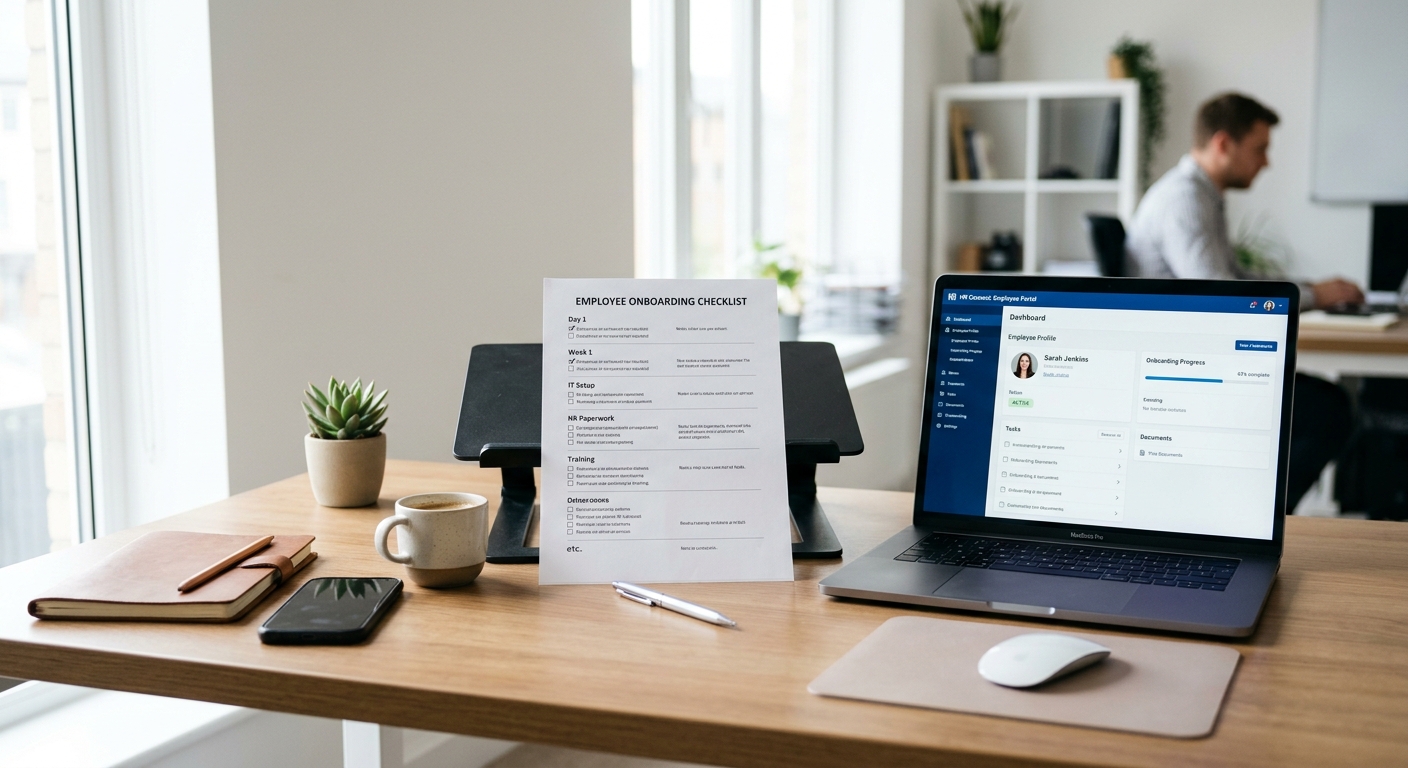
Onboarding Checklists That Adapt Instead of Stale PDFs
Traditional onboarding checklists are static documents that get outdated quickly. Someone adds a new tool, changes a process, or updates a compliance requirement, and nobody remembers to update the PDF stored in the shared drive. Six months later, new hires follow instructions that no longer match reality.
AI-generated checklists stay current because you regenerate them when processes change. Describe what has shifted, and the AI updates the entire checklist while preserving the structure that works.
Day One Through Day Ninety Structure
Effective onboarding extends beyond the first week. Organizations that extend onboarding to at least 90 days see significantly better outcomes across retention, engagement, and productivity metrics. A well-structured 90-day plan includes:
- Week one: Intensive orientation covering essential policies, systems access, team introductions, and initial role clarity.
- First month: Structured learning aligned with responsibilities and initial performance milestones.
- First quarter: Ongoing development, regular check-ins, and embedding of performance support.
AI generates each phase's checklist based on the role, department, and company context. A customer success rep gets different week-one priorities than a finance analyst. The same framework applies, but the content adapts.
Compliance and Documentation Built In
Compliance tracking eats HR time across every industry. Background checks, document collection, benefits enrollment, and regulatory forms vary by location and role. AI can generate role-and-location-specific compliance checklists that ensure nothing gets missed.
For Indian companies, this means GST-related documentation, PF enrollment, ESOP paperwork, and state-specific labor law requirements all appear in the right checklist at the right time. No more digging through legal memos to remember what is required for a hire in Karnataka versus Maharashtra.
Employee Communications That Do Not Sound Like Templates
Internal communications are another area where small companies struggle. Welcome emails, policy announcements, meeting notes, and project updates often sound stiff and corporate because someone is writing them under time pressure without a clear framework.
AI drafts communications in your company's voice. Feed it a few examples of how you normally write, and it learns the tone. Policy updates become clear and readable instead of dense legal language. Welcome messages feel personal even when sent to multiple new hires in the same batch.
Drafting Policy Documents Faster
Company handbooks, code of conduct documents, and HR policies take weeks to write from scratch. AI cuts that timeline dramatically by generating first drafts based on your requirements and industry standards.
You tell it what you need: a remote work policy for a distributed engineering team, a performance review framework for a growing sales organization, or an updated leave policy that complies with Indian labor laws. The AI produces a structured draft that your legal team reviews and refines. What used to take weeks of back-and-forth now takes days.
Meeting Notes and Action Items Without Manual Transcription
HR runs meetings constantly: manager calibration sessions, new hire feedback reviews, policy discussion workshops, and cross-functional alignment calls. Taking notes while facilitating leaves gaps in documentation. Recording everything and transcribing manually wastes time.
AI captures meeting audio, transcribes it, extracts key decisions, and generates structured action items with owners and deadlines. Your meeting notes become actionable records instead of vague summaries nobody reads later.
How Zosma Helps with HR Onboarding and Communications
Zosma Cowork addresses the gap between enterprise onboarding platforms and manual spreadsheet-based processes. It runs as a free desktop harness on your PC — you pay as little as ₹500/month for the AI brain, and your context stays local.
- Generate role-specific onboarding checklists: Describe the position, team, and company context. Cowork produces a structured 90-day onboarding plan with week-by-week milestones, compliance requirements, and manager touchpoints.
- Draft employee communications instantly: Welcome emails, policy announcements, meeting summaries, and project updates written in your company's voice. No more generic templates.
- Create and update HR documents on demand: Handbooks, codes of conduct, performance frameworks, and compliance guides generated from your requirements and refined iteratively.
- Local AI keeps employee data private: All processing runs on your machine. Sensitive information like employee names, salaries, performance notes, and medical documentation never reaches cloud providers like Anthropic, OpenAI, Google, Meta, or Chinese AI labs. You can share almost anything with zero risk.
Cowork handles the document-heavy, repetitive work that drains HR capacity. You focus on building relationships, coaching managers, and creating the culture that actually retains people.
Start using Cowork for your HR workflows
Frequently Asked Questions
Can Zosma Cowork replace an enterprise onboarding platform?
Not entirely, and it does not need to. Cowork handles the document generation, checklist creation, and communication drafting that consume most HR time. Large enterprises still need dedicated platforms for workflow orchestration, system integrations, and analytics across thousands of employees. For small and mid-sized teams, Cowork covers the core needs without subscription overhead.
Is my employee data safe when using local AI?
Yes. Cowork runs models directly on your desktop hardware. Employee information never leaves your machine unless you explicitly upload or share it. Cloud providers like Anthropic, OpenAI, Google, Meta, and Chinese AI labs cannot see your data because the model processes everything locally. You only pay for electricity.
How long does it take to set up onboarding workflows in Cowork?
You can generate your first onboarding checklist in minutes. Describe the role, mention your company size and industry, and Cowork produces a structured plan. Refining it to match your exact processes takes another session or two. Once you have a good template, you reuse and adapt it for similar roles.
Does Cowork work for HR teams in India?
Yes. Cowork generates content in English and can incorporate Indian labor law requirements, GST documentation needs, PF/ESIC compliance, and other local regulations into its checklists and documents. You provide the specifics, and the AI structures them properly.
What happens if I need to onboard many people at once?
Cowork scales with your workload. Generate a base onboarding plan for a role type, then adapt it for each individual hire. The AI personalizes details while keeping the core structure consistent. You maintain quality and completeness across batch hires without multiplying your effort.